


Top Rated New York Longshoreman injury Law Firm – Grossman Attorneys
If you were injured working on a New York dock, pier, or vessel, you need an attorney who understands the federal protections available to longshore and harbor workers. Standard workers’ compensation doesn’t apply to your situation. The Longshore and Harbor Workers’ Compensation Act provides specific benefits, but insurance companies often try to minimize payouts or deny valid claims entirely.
Grossman Attorneys at Law has extensive experience representing injured port workers under the LHWCA. Our team knows how to build strong cases that hold insurers accountable. We’ve secured substantial settlements through skilled negotiation, and when insurance companies refuse to offer fair compensation, we’re prepared to take your case to trial.
You’ve worked hard to support your family. Now it’s time to fight for the benefits you’ve earned. Contact us today for a free consultation about your longshore injury claim.
Understanding the Longshore and Harbor Workers’ Compensation Act (LHWCA)
If you’ve been injured while working on New York’s docks, waterfront facilities, or harbors, you’re likely covered under the Longshore and Harbor Workers’ Compensation Act (LHWCA). This federal law provides specific benefits and protections for maritime workers who don’t qualify as traditional seamen, creating a middle ground between standard workers’ compensation and maritime law.
Understanding whether you qualify, what benefits you can receive, and how LHWCA differs from other maritime protections is essential to securing the full compensation you deserve after a workplace injury. Under the LHWCA, employers must secure insurance or self-insure to pay benefits, and a federally administered Special Fund helps cover certain claims when responsible employers or insurers cannot.
What is LHWCA Coverage?
The Longshore and Harbor Workers’ Compensation Act (LHWCA) kicks in when workers suffer injuries while performing maritime employment on or near navigable waters. This federal law provides medical benefits, disability compensation, and vocational rehabilitation to covered employees.
Coverage scope extends to dock workers, shipbuilders, harbor construction workers, and others engaged in maritime operations. Claimant eligibility requires meeting two tests: the status test, confirming you’re a maritime employee, and the situs test, proving your injury occurred on navigable waters or adjoining areas like piers, wharves, docks, or terminals where loading, unloading, building, or repairing vessels occurs. The program is administered by the OWCP/DLHWC, which oversees claims, benefits, and dispute resolution under the LHWCA.
Who Qualifies for LHWCA Benefits?
Maritime workers who meet specific legal criteria can access LHWCA benefits, regardless of whether they traditionally identify as longshoremen. Benefits eligibility depends on two factors: your work involves maritime employment, and your injury occurred on navigable waters or adjacent areas like piers, docks, or terminals.
The law covers stevedores, ship repairers, shipbuilders, harbor construction workers, and similar occupations. You don’t need a job title containing “longshore” to qualify. If you load cargo, repair vessels, or perform maritime-related work in covered locations, you likely meet the requirements for compensation and medical benefits under federal law. Covered sites include piers, wharves, dry docks, terminals, shipyards, and marine railways, as well as other adjoining areas customarily used for vessel-related activities.
How Does LHWCA Differ from Other Maritime Laws?
Understanding which law applies to your injury matters because it determines what benefits you’ll receive and how you’ll pursue compensation. LHWCA provides workers’ compensation benefits, while Jones Act claims involve employer negligence lawsuits with potentially higher awards.
Comparative jurisdiction questions often arise when workers perform duties both on vessels and shore facilities. LHWCA uses specific benefit calculation formulas based on your average weekly wage, capping maximum compensation amounts. The Jones Act allows jury trials and compensation for pain and suffering. General maritime law covers still other scenarios. Getting the classification right directly impacts your financial recovery.
Major Ports and Maritime Facilities in New York
Port of New York and New Jersey
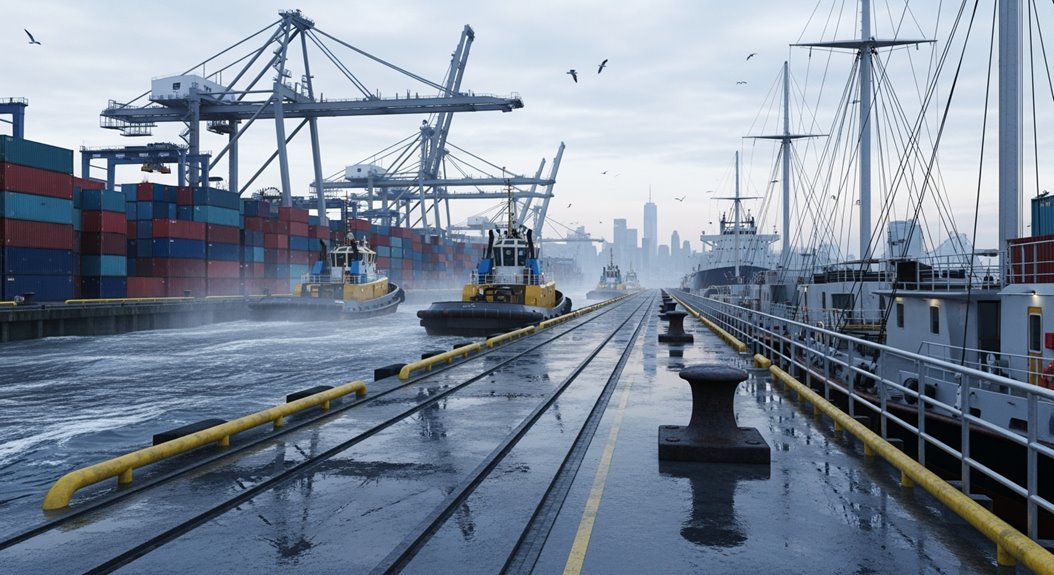
The Port of New York and New Jersey spans waterfront facilities across both states, with major terminals in Newark, Elizabeth, Jersey City, and Staten Island on the New Jersey side, and Brooklyn, Queens, and Staten Island on the New York side. Major terminal operators include APM Terminals, Maher Terminals, GCT New York, and Port Newark Container Terminal.
The port serves as a critical gateway for containerized cargo, automobiles, bulk commodities, and breakbulk freight, supporting industries ranging from retail and manufacturing to energy and agriculture. The port handles over 6.25 million twenty-foot equivalent units (TEUs) annually, making it the third-busiest container port in the United States. It employs approximately 400,000 workers directly and indirectly across the maritime supply chain, including longshoremen, crane operators, truckers, and warehouse personnel.
Recent infrastructure investments exceed $4 billion, including projects to raise the Bayonne Bridge for larger vessels and modernize terminal facilities with advanced cargo-handling equipment. The port generates an estimated $200 billion in annual economic activity for the region.
Port of Albany
The Port of Albany is located along the Hudson River in New York’s capital region, approximately 150 miles north of New York City. The port serves as a critical inland hub operated by the Albany Port District Commission, with major tenants including Cargill, Callanan Industries, and various steel and heavy equipment importers.
The facility specializes in handling bulk commodities such as grain, salt, scrap metal, and petroleum products, as well as heavy-lift project cargo and wind energy components. The Port of Albany moves over 4 million tons of cargo annually through its facilities, which include 200 acres of port property and five deep-water berths. The port directly employs several hundred workers and supports thousands of additional jobs in transportation, warehousing, and related industries throughout the Capital Region.
Recent investments have focused on modernizing cargo handling equipment and improving rail connections, with ongoing development projects valued at over $50 million to expand capacity for renewable energy equipment and breakbulk cargo.
Port of Buffalo
The Port of Buffalo is situated on the eastern shore of Lake Erie and the Niagara River in western New York, serving as a vital Great Lakes maritime gateway. The port is managed by the Niagara Frontier Transportation Authority and hosts operations by companies including Federal Marine Terminals, GLF Stevedoring, and various grain handlers and bulk cargo operators.
The facility specializes in handling agricultural products, steel, construction materials, and general cargo connecting Great Lakes shipping routes with inland distribution networks. The Port of Buffalo processes approximately 3 million tons of cargo annually, with grain exports representing a significant portion of throughput. The port employs hundreds of maritime workers directly and supports several thousand jobs in the broader Buffalo-Niagara regional economy.
Infrastructure improvements have included upgrades to dock facilities, grain elevators, and cargo handling systems, with recent investments totaling over $30 million aimed at expanding capacity and modernizing operations to serve growing agricultural export markets and construction material imports. Ports across New York can access federal planning and investment resources through the MARAD Ports Portal, which consolidates programs that support port development and infrastructure modernization.

Common Longshore and Dock Worker Accidents in New York
Because of the intense physical demands and hazardous conditions at New York’s busy ports and terminals, longshore and dock workers face serious injury risks every day they report to work.
These accidents often stem from:
- Falls from heights due to inadequate night lighting and unmarked hazards on gangways and vessel decks
- Struck-by incidents involving swinging cargo, moving containers, and heavy equipment in crowded conditions
- Crush injuries from poor dock ergonomics and being caught between machinery or stacked goods
Exposure to hazardous substances, slippery surfaces, and malfunctioning equipment further compound these dangers, frequently resulting in catastrophic injuries requiring extensive medical treatment. OSHA highlights common longshoring hazards and provides resources on marine terminals to help prevent these types of accidents.
Longshore and Port Worker Injury Statistics in New York
The scope of workplace dangers facing New York’s longshore and port workers becomes clearer when examining the numbers. While dedicated port-specific data remains limited, construction-related statistics reveal alarming injury trends:
- NYC construction fatalities reached 30 deaths in 2023, the highest count in over a decade
- Worker demographics show Latinx workers face disproportionate risk, comprising 26% of fatality victims despite representing only 10% of the workforce
- Safety violations were found at 74% of worksites where fatal accidents occurred
These figures underscore the persistent hazards confronting maritime workers throughout New York’s busy ports and waterfront facilities. Moreover, nationally, the water transportation industry’s fatality rate is 4.7 times higher than the rate for all U.S. workers, highlighting the elevated risks faced by maritime workers.
Insurance companies know our reputation. They know we prepare every case for trial and we’ll go the distance when settlement offers fall short. We investigate thoroughly, build bulletproof cases, and aren’t afraid to take yours to court. That changes negotiations from the start.
Anytime. Anywhere. We’re Ready to Fight for You.
Compensation Available for Longshoremen in New York
When you're injured while working on New York's docks or waterfront, the Longshore and Harbor Workers' Compensation Act provides several types of financial protection to help you recover and support your family.
These benefits cover your immediate medical needs, replace lost wages during your recovery, and protect your dependents if the worst happens. Understanding what compensation you're entitled to helps guarantee you receive everything the law provides for your longshore injury.
Medical Benefits
Injured longshoremen in New York receive full coverage for all reasonable and necessary medical treatment related to their workplace injuries under the Longshore and Harbor Workers' Compensation Act. This includes doctor visits, surgeries, physical therapy, medications, and medical equipment. You won't pay out-of-pocket costs for approved care.
However, insurance carriers sometimes create treatment delays by disputing whether specific procedures are necessary. Proper medical recordkeeping becomes essential when carriers challenge your treatment needs. You'll need documentation showing how each treatment directly addresses your work-related injury. We'll make certain you receive timely medical care while building evidence to overcome any insurance company objections.
Disability Benefits
Understanding disability benefits starts with recognizing how the Longshore Act compensates you based on your injury's impact on your earning capacity. You'll receive two-thirds of your average weekly wage if you can't work during recovery.
Permanent disability payments depend on whether your injury limits specific body functions or your overall ability to earn income. The insurer may request psychological evaluations to assess mental injury claims or determine your work capacity. If your injury prevents you from returning to your previous job, you might qualify for vocational rehabilitation services that help you develop new marketable skills for alternative employment.
Death Benefits
If your loved one dies from a longshore work accident in New York, the Longshore and Harbor Workers' Compensation Act provides financial support to help your family maintain stability during an impossibly difficult time.
Survivor compensation includes weekly payments to eligible dependents, typically two-thirds of your loved one's average weekly wages. Spouses generally receive benefits until remarriage, while dependent children receive support until age eighteen or longer if enrolled in school.
The Act also provides burial assistance up to $3,000 to help cover funeral expenses. These death benefits make sure families aren't left financially devastated after losing their primary income earner to a workplace tragedy.
Additional Damages
Beyond the core benefits provided under the Longshore and Harbor Workers' Compensation Act, injured longshoremen in New York may pursue additional damages when third parties share responsibility for their injuries.
If a negligent vessel owner, equipment manufacturer, or contractor contributed to your accident, you can file a separate lawsuit outside the LHWCA system. These claims may include compensation for emotional distress, the psychological impact of your injury, and in cases of egregious misconduct, punitive damages designed to punish wrongdoers. Third-party claims often provide substantially greater compensation than LHWCA benefits alone, making thorough investigation of all responsible parties essential.
Statute of Limitations for Filing a LHWCA Claim
When you're injured on the job as a maritime worker, time becomes one of your most critical concerns. The LHWCA imposes strict claim deadlines that can bar your recovery if missed.
You must notify your employer of your injury within 30 days, though exceptions exist for delayed-discovery injuries. The filing deadlines for formal claims are more generous, you have one year from the injury date or the last voluntary compensation payment to file.
These timeframes aren't negotiable. Missing them means losing your right to benefits entirely, regardless of how severe your injuries are or how clear your employer's liability.
Get Results
Each one of our lawyers is a skilled and experienced litigator and negotiator. We never recommend settling your case when trial presents a better opportunity for recovery.



Why Do I Need a Longshoremen Workers Comp Injury Lawyer?
Understanding these deadlines highlights a larger reality: LHWCA claims aren't simple workers' compensation cases. They're federal proceedings with complex procedures that trip up even experienced general practice attorneys. Evidence preservation becomes critical immediately after your injury, witness statements fade, surveillance footage gets deleted, and physical conditions at accident sites change. Insurance companies employ specialized defense teams who know exactly how to minimize your claim.
Settlement timing matters tremendously; accepting an offer too early means you can't reopen your case if complications develop. You need an attorney who handles LHWCA cases daily and understands maritime employers' tactics.
Why Choose Grossman Attorneys for Your New York LHWCA Claim
When you're injured on the job as a maritime worker in New York, you need attorneys who won't back down from insurance companies or their defense lawyers.
Grossman Attorneys at Law is a respected maritime law firm with over 40 years of experience representing injured workers across the nation. Our maritime lawyers have secured substantial settlements and verdicts in cases ranging from Defense Base Act claims to longshoremen workers' comp injury cases and offshore accidents. We understand the complex laws that govern these claims and stand ready to take your case to trial when insurance companies fail to offer the fair compensation you deserve.
Aggressive But Fair Representation
Insurance companies and employers count on injured maritime workers accepting less than they deserve. We disrupt that expectation through assertive negotiation backed by thorough case preparation.
Our approach combines aggressive advocacy with unwavering ethical standards. We push hard for maximum compensation while maintaining professional integrity in every interaction. Defense attorneys recognize our willingness to proceed to trial rather than accept inadequate offers. This reputation strengthens our negotiating position before litigation begins.
Our ethical litigation practices mean we build cases on solid evidence and honest representation, never resorting to questionable tactics that could undermine your claim's credibility or ultimate success.
Experienced, Compassionate Staff
Behind every successful longshore claim stands a dedicated team that understands both the law and the human impact of maritime injuries. Our staff combines decades of legal experience with trauma informed advocacy, recognizing that workplace accidents affect every aspect of your life.
We've trained our team to listen carefully, respond promptly, and explain complex legal matters in straightforward terms. Through staff led outreach, we maintain regular communication throughout your case, ensuring you're never left wondering about your claim's status. You'll work with professionals who treat your case with the urgency and respect it deserves.
A Track Record of Winning Longshore Claims
Results speak louder than promises in longshore litigation, and our firm's history demonstrates consistent success in securing maximum compensation for injured maritime workers. We've built numerous multi-million-dollar settlements through strategic preparation and unwavering advocacy.
Our settlement strategies focus on documenting every aspect of your claim while our trial preparation sends a clear message to insurance carriers: we're ready for court if they won't negotiate fairly. Defense attorneys recognize our thoroughness, which often leads to better settlement offers. When settlements fall short, we don't hesitate to pursue full compensation through trial, protecting your rights at every stage.
Injured at a New York Port? Let Grossman Attorneys Fight for Your LHWCA Compensation
If you or a loved one has been injured while working at a New York port, you don't have to face the complex LHWCA claims process alone.
Grossman Attorneys at Law has spent over 40 years securing maximum compensation for injured maritime workers nationwide, and we're ready to put that experience to work for you. We recognize the physical, emotional, and financial toll these injuries take on workers and their families.
Our litigation-first approach means we won't settle for less than you deserve, we'll take your case to trial if necessary to fight for full compensation. Don't let insurance companies minimize your claim. Contact Grossman Attorneys today to speak with an experienced LHWCA attorney who'll prioritize your recovery and your rights.
*If you hire Grossman Attorneys for your LHWCA case, you pay no attorney fees for our service. When we win your case, the employer or its insurer typically pays a DOL-approved attorney’s fee and any case expenses we advanced are reimbursed from the recovery. If we don't win, you pay nothing.
- https://www.freightmango.com/port-info/us/newyork-usnyc/
- https://sustainableworldports.org/wpcap/wg-5/our-mission/port-of-new-york-and-new-jersey/
- https://www.marineinsight.com/know-more/major-u-s-east-coast-ports/
- https://www.worldshipping.com/portfolio/port-of-buffalo-buffalo-new-york/
- https://www.panynj.gov/port-authority/en/blogs/facilities.html
- https://www.panynj.gov/port/en/our-port.html
- https://www.panynj.gov/port-authority/en/building-the-region/office-commercial-facilities.html
- https://www.portofalbany.us
- https://transportgeography.org/contents/applications/port-authority-new-york-new-jersey/facilities-port-authority-new-york-map/