


Top Rated Connecticut Longshoreman injury Law Firm – Grossman Attorneys
When you’re injured working on Connecticut’s docks, piers, or shipyards, you’re not covered by standard workers’ compensation. Instead, you fall under the federal Longshore and Harbor Workers’ Compensation Act, a complex system with different benefits, stricter deadlines, and unique filing requirements. Without an attorney who understands LHWCA claims inside and out, you risk losing benefits you’ve rightfully earned through years of hard labor.
Grossman Attorneys at Law has extensive experience handling longshore injury cases throughout Connecticut. Our team knows how to navigate federal maritime law, negotiate aggressively with insurance carriers, and take cases to trial when settlement offers fall short. We’ve recovered substantial compensation for injured port workers and their families.
Your injury shouldn’t cost you your livelihood or financial security. Call us today for a free consultation and let us fight for the full benefits you deserve.
Understanding the Longshore and Harbor Workers’ Compensation Act (LHWCA)
If you’ve been injured while working on Connecticut’s docks, waterfronts, or maritime facilities, you’re likely covered under the Longshore and Harbor Workers’ Compensation Act (LHWCA). This federal law provides specific protections and benefits for maritime workers who don’t qualify as seamen under the Jones Act but work in maritime employment.
Understanding what the LHWCA covers, who qualifies for benefits, and how it differs from other maritime laws is essential to protecting your right to compensation after a workplace injury. Under the LHWCA, disability benefits are based on your pre-injury wage and adjusted annually according to the National Average Weekly Wage, with no deductibles or copays for covered medical care.
What is LHWCA Coverage?
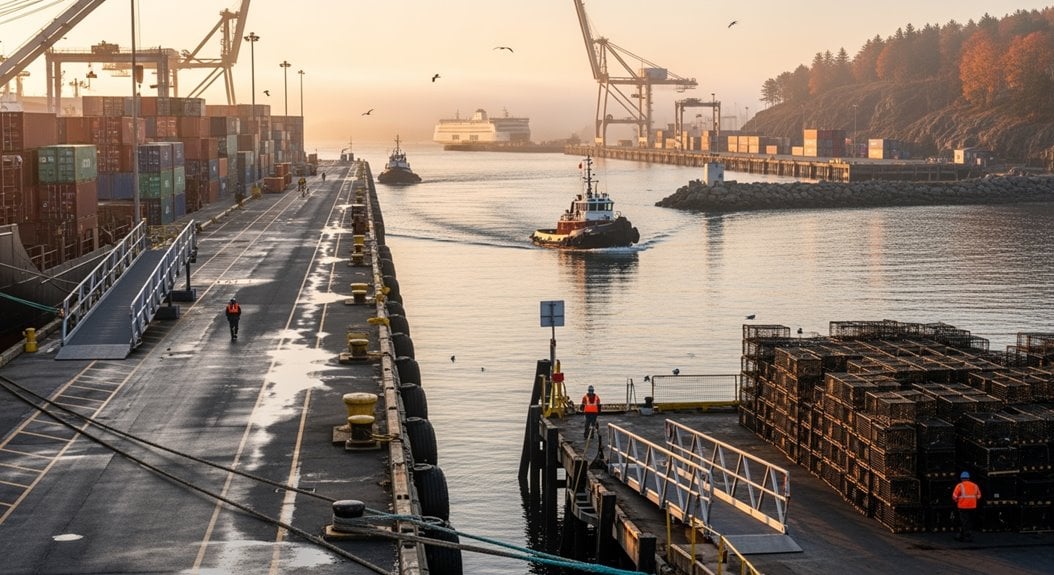
When you work on or near navigable waters in Connecticut—whether at a dock in New Haven Harbor, a shipyard in Groton, or a cargo terminal in Bridgeport—you’re likely covered under the Longshore and Harbor Workers’ Compensation Act (LHWCA).
This federal law protects maritime workers who load cargo, repair vessels, build ships, and perform similar duties. Coverage scope extends to injuries occurring on piers, docks, terminals, and other maritime facilities. However, exclusion criteria apply to certain workers, including vessel crew members covered under different maritime laws and office employees who don’t engage in maritime work.
Understanding your coverage status is essential for protecting your rights. You also have the right to choose your initial treating physician under the LHWCA, subject to approval for any changes by the OWCP/DLHWC.
Who Qualifies for LHWCA Benefits?
Determining whether you qualify for LHWCA benefits requires meeting two essential tests: the status test and the situs test.
The status test examines your employment role—you must work as a maritime employee but not qualify as a seaman. The seaman exclusion is significant because traditional seamen fall under different maritime laws.
The situs test evaluates your work location—you must perform duties on navigable waters or adjoining areas like piers, docks, or terminals where loading, unloading, or ship-building occurs.
LHWCA eligibility depends on satisfying both tests simultaneously when your injury happens. In addition, coverage applies to injuries occurring upon navigable waters and adjoining areas such as wharves, dry docks, shipyards, terminals, and marine railways used for loading, unloading, repairing, dismantling, or building vessels.
How Does LHWCA Differ from Other Maritime Laws?
Maritime law encompasses several distinct legal frameworks, and understanding where LHWCA fits within this landscape directly affects your compensation rights and legal options. Unlike the Jones Act, which requires you to prove employer negligence, LHWCA provides no-fault compensation regardless of fault.
Coverage overlaps can occur between LHWCA and state workers’ compensation systems, particularly for injuries occurring on navigable waters. Comparative jurisprudence reveals that LHWCA generally offers more substantial benefits than traditional workers’ compensation.
If you’re injured while working on Connecticut’s docks or harbors, you’ll likely pursue LHWCA benefits rather than filing a personal injury lawsuit.
Major Ports and Maritime Facilities in Connecticut
Port of New Haven
Located in the central Connecticut coastline between Boston and New York, the Port of New Haven operates seven specialized terminals handling diverse cargo operations. Major operators include Gateway Terminal, Exxonmobil, PIRHL (Petroleum Import Receiving and Handling Logistics), and New Haven Terminal. The port specializes in petroleum products, cement, steel, salt, and various bulk commodities, serving as a critical supply point for the region’s construction and energy sectors.
The port ranks 53rd nationally in cargo volume, handling approximately 3.5 million tons of cargo annually. The facility employs several hundred maritime workers including longshore laborers, stevedores, and terminal operators. Recent infrastructure investments have focused on terminal modernization and environmental compliance upgrades, supporting the port’s role as a significant economic contributor to the New Haven metropolitan area. The port’s facilities are also documented in the USACE WCSC navigation dataset that maps navigation and waterway infrastructure.
Port of Bridgeport
Situated on Connecticut’s southwestern coast, the Port of Bridgeport serves as a versatile cargo handling facility with capabilities for breakbulk and roll-on/roll-off (RoRo) operations. The port accommodates various shipping lines and cargo operators while maintaining its connection to the city’s rich maritime heritage.
Operations support regional manufacturing, construction materials distribution, and general cargo movements throughout southern New England. The port handles hundreds of thousands of tons of cargo annually, employing dock workers, equipment operators, and support personnel. The facility has seen investments in infrastructure improvements to expand capacity and accommodate larger vessels, contributing to Bridgeport’s waterfront economic development alongside maritime-themed community events and festivals that celebrate the port’s historical significance.
Port of New London
Located in southeastern Connecticut, the Port of New London operates as a multi-purpose facility serving both military and commercial interests. The port provides critical support to the U.S. Coast Guard Academy and Naval Submarine Base New London while hosting State Pier, which has been designated as a staging and assembly facility for offshore wind energy projects.
This unique combination creates employment across defense logistics, commercial shipping, and emerging renewable energy sectors. The port is undergoing significant transformation with major state and federal investments exceeding $255 million to develop offshore wind infrastructure, positioning Connecticut as a key player in the Atlantic offshore wind industry. Combined military and commercial operations support thousands of direct and indirect jobs, with cargo operations handling fuel, construction materials, and specialized equipment. The offshore wind development is projected to create hundreds of additional maritime jobs while establishing New London as a regional offshore wind hub.
Common Longshore and Dock Worker Accidents in Connecticut
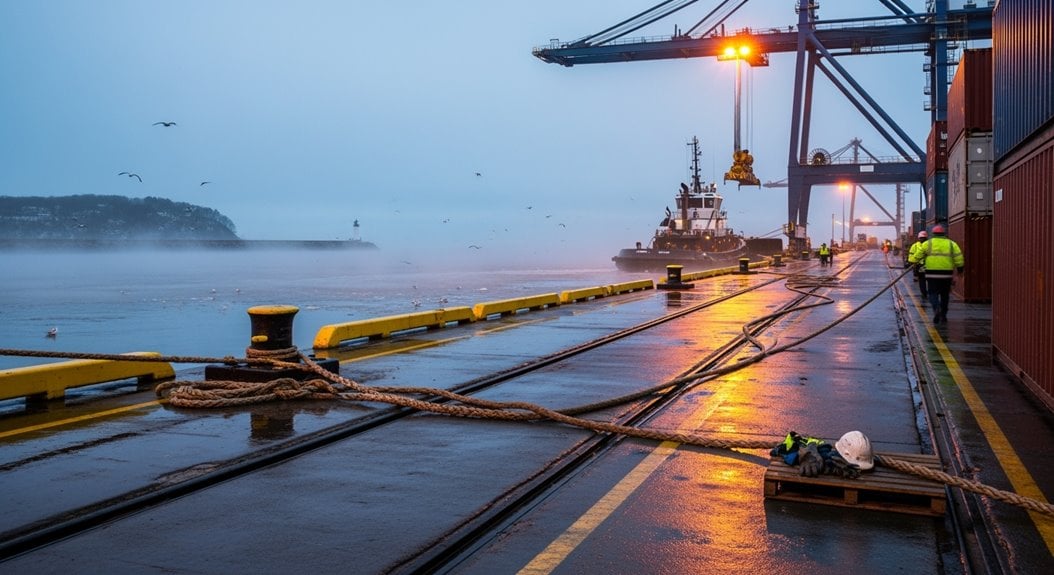
Working in Connecticut’s ports and maritime facilities exposes longshore workers and dock personnel to serious injury risks every single day. Despite improvements in dock ergonomics and weather preparedness, accidents continue causing devastating injuries.
You face hazards from heavy machinery, slippery surfaces, and confined spaces throughout your shift.
Common accident types include:
- Heavy equipment collisions involving cranes, forklifts, and cargo handling machinery
- Slips and falls on wet decks and oil-covered surfaces
- Crush injuries during loading and unloading operations
- Confined space accidents in cargo holds and fuel tanks
- Struck-by incidents from falling cargo or swinging loads
These preventable accidents often stem from inadequate training or safety violations.
OSHA’s marine terminal and longshoring standards provide detailed requirements for training, equipment, and hazard controls to prevent these incidents, as outlined in the OSHA Compliance Guide.
Longshore and Port Worker Injury Statistics in Connecticut
Although Connecticut lacks industry-specific tracking data for longshore and port worker injuries, the state’s 2023 Occupational Disease Report reveals concerning trends that directly affect workers in these maritime roles.
Key injury statistics affecting Connecticut maritime workers:
- Over 31,000 occupational disease cases reported statewide in 2023
- Musculoskeletal disorders from poor port ergonomics lead all injury categories
- Workers over 60 average 97 days away from work per injury
- Cargo contamination exposures rank as second-highest disease category
- Average recovery time increased to 80 workdays across all injuries
These statistics underscore the serious health risks you face in maritime work. For deeper legal context and case interpretations relevant to maritime injuries, the BRB Longshore Deskbook offers explanations of LHWCA topics and case law.
Insurance companies know our reputation. They know we prepare every case for trial and we’ll go the distance when settlement offers fall short. We investigate thoroughly, build bulletproof cases, and aren’t afraid to take yours to court. That changes negotiations from the start.
Anytime. Anywhere. We’re Ready to Fight for You.
Compensation Available for Longshoremen in Connecticut
If you've been injured while working at a Connecticut port or shipyard, you're entitled to specific benefits under the Longshore and Harbor Workers' Compensation Act. These benefits provide thorough coverage that goes beyond standard workers' compensation, addressing your medical needs, lost income, and long-term care requirements.
Understanding what compensation you can claim helps make certain you receive every benefit the law guarantees you.
Medical Benefits
Recovering from a workplace injury shouldn't drain your savings or force you to choose between medical care and paying bills. Under the Longshore Act, you're entitled to full medical coverage for work-related injuries without out-of-pocket costs.
Your employer must provide medical authorization promptly and cover all reasonable treatment. Treatment coordination guarantees you receive appropriate care from qualified physicians, specialists, surgeries, medications, physical therapy, and necessary medical equipment.
Connecticut longshoremen can access medical benefits regardless of disability status. If your employer delays authorization or disputes necessary treatment, you maintain the right to challenge these decisions through formal procedures.
Disability Benefits
Beyond covering your medical expenses, the Longshore Act provides direct financial compensation when injuries prevent you from working.
You're entitled to total disability benefits if you can't work at all, or partial disability payments if you can perform limited duties. These benefits continue until you reach maximum medical improvement, meaning your condition has stabilized. If you suffer permanent impairment, you'll receive compensation based on the severity of your lasting limitations.
The Act also provides vocational rehabilitation services to help you shift to suitable work when your original job duties become impossible due to your injuries.
Death Benefits
When a workplace accident takes a Connecticut longshoreman's life, the Longshore and Harbor Workers' Compensation Act provides death benefits to help surviving family members manage their financial loss.
You'll receive compensation covering funeral expenses up to $3,000 and ongoing payments equal to two-thirds of your loved one's average weekly wage. Eligible survivors include spouses, children, and dependent parents. These benefits continue until children reach adulthood or spouses remarry. You're also entitled to survivor counseling and bereavement support services to help your family cope with this devastating loss.
Grossman Attorneys at Law guarantees you receive every benefit you're owed during this difficult time.
Additional Damages
Your compensation under the Longshore and Harbor Workers' Compensation Act extends well past death benefits to include several forms of additional damages that address the full scope of your losses. You may recover compensation for emotional distress stemming from your injury, acknowledging the psychological impact of workplace accidents.
In cases involving gross negligence or intentional misconduct by third parties, punitive damages become available to penalize wrongdoers and deter similar conduct. These additional remedies recognize that workplace injuries affect more than just your physical health and earning capacity, addressing the broader consequences of maritime accidents.
Statute of Limitations for Filing a LHWCA Claim
Time limits matter markedly in Longshore and Harbor Workers' Compensation Act cases, and missing a critical deadline can forfeit your right to compensation entirely.
You typically must notify your employer of your injury within 30 days and file your claim within one year of the accident or the date you discovered your work-related condition. These filing deadlines contain statute nuances that can extend or shorten your window depending on your specific circumstances.
Connecticut maritime workers who delay reporting injuries risk losing benefits they've rightfully earned through their dangerous work on docks, piers, and vessels.
Get Results
Each one of our lawyers is a skilled and experienced litigator and negotiator. We never recommend settling your case when trial presents a better opportunity for recovery.



Why Do I Need a Longshoremen Workers Comp Injury Lawyer?
Maneuvering the Longshore and Harbor Workers' Compensation Act requires specialized legal knowledge that most general practice attorneys simply don't possess. An experienced longshore lawyer understands complex maritime jurisdiction issues and how to maximize your benefits under federal law.
They'll handle evidence preservation, ensuring critical documentation of your injury and working conditions remains intact. Your attorney manages settlement negotiation with insurance carriers who routinely minimize claims.
Without proper legal representation, you risk accepting inadequate compensation or missing filing deadlines. A skilled longshore attorney protects your rights while you focus on recovery, fighting for the full benefits you've earned.
Why Choose Grossman Attorneys for Your Connecticut LHWCA Claim
When you're facing a Connecticut LHWCA claim, you need attorneys who won't back down from insurance companies or accept less than full compensation for your injuries.
Grossman Attorneys at Law is a respected maritime law firm with over 40 years of experience representing injured workers across the nation. Our maritime law firm have secured substantial settlements and verdicts in cases ranging from Defense Base Act claims to longshoremen workers' comp injury cases and offshore accidents. We understand the complex laws that govern these claims and stand ready to take your case to trial when insurance companies fail to offer the fair compensation you deserve.
Aggressive But Fair Representation
Insurance companies know which law firms will fight for full compensation and which will settle quickly for less than a case is worth. Grossman Attorneys has built a reputation for zealous advocacy that defense carriers respect and respond to accordingly.
When you're represented by a firm willing to litigate rather than settle prematurely, insurance adjusters approach negotiations differently. The firm combines aggressive case preparation with ethical negotiation practices that protect your interests while maintaining professional standards. This balanced approach means you'll receive maximum compensation without unnecessary delays, getting the financial support you need when you need it most.
Experienced, Compassionate Staff
Behind every successful case outcome stands a dedicated team of legal professionals who understand that LHWCA claims involve more than statutes and settlement negotiations—they involve people facing financial uncertainty and physical recovery.
Our staff receives ongoing empathy training to make sure you're treated with dignity throughout your claim. We recognize that injured longshoremen need clear communication during stressful times. Our client outreach protocols include regular case updates and prompt responses to your questions.
You'll work with paralegals, case managers, and attorneys who combine technical knowledge with genuine concern for your wellbeing. This approach transforms complex legal proceedings into manageable steps toward fair compensation.
A Track Record of Winning Longshore Claims
Although past results can't guarantee future outcomes, our firm's history of securing substantial settlements and favorable verdicts demonstrates our capability to handle Connecticut LHWCA claims effectively.
Our verdict consistency reflects thorough case preparation and skilled courtroom advocacy that insurance carriers respect. We've recovered millions for injured maritime workers by understanding settlement dynamics, when to negotiate and when to litigate. Defense attorneys recognize our willingness to take cases to trial rather than accept inadequate offers. This reputation strengthens our negotiating position and helps us secure maximum compensation.
Your Connecticut longshore claim deserves attorneys who've proven they'll fight for full recovery.
Injured at a Connecticut Port? Let Grossman Attorneys Fight for Your LHWCA Compensation
If you or a loved one has suffered an injury while working at a Connecticut port or maritime facility, you don't have to navigate the complex LHWCA claims process alone.
Grossman Attorneys at Law has spent over four decades fighting for injured maritime workers nationwide, securing the maximum compensation our clients deserve. We appreciate the physical, emotional, and financial toll these injuries take on workers and their families. Our litigation-first approach means insurance carriers know we're prepared to take your case to trial if necessary to achieve full compensation.
Don't accept less than you're entitled to under the Longshore and Harbor Workers' Compensation Act. Contact Grossman Attorneys today to speak with an experienced LHWCA attorney who'll fight tirelessly for your rights.
*If you hire Grossman Attorneys for your LHWCA case, you pay no attorney fees for our service. When we win your case, the employer or its insurer typically pays a DOL-approved attorney’s fee and any case expenses we advanced are reimbursed from the recovery. If we don't win, you pay nothing.
- https://www.unisco.com/us-ports/connecticut-port-authority
- https://ctportauthority.com/connecticuts-deepwater-ports/
- https://portal.ct.gov/dot/publictrans/bureau-of-public-transportation/state-maritime-office
- https://www.newhavenct.gov/government/departments-divisions/port-authority/port-of-new-haven
- https://www.newhavenct.gov/government/port-of-new-haven/port-authority
- https://www.maritimeprofessional.com/news/port-profile-haven-connecticut-313266
- https://www.cga.ct.gov/2010/rpt/2010-R-0284.htm
- https://ctportauthority.com
- https://www.maritime.dot.gov/data-reports/ports/list
- https://mysticseaport.org