


Top Rated Virginia Longshoreman injury Law Firm – Grossman Attorneys
If you work at a Virginia port and suffered an injury on the job, you need legal representation that understands the federal Longshore and Harbor Workers’ Compensation Act. Unlike standard workers’ compensation claims, LHWCA cases involve complex federal regulations that require specialized knowledge and experience.
Grossman Attorneys at Law has spent years mastering the intricacies of longshore injury claims. Our attorneys know how to negotiate effectively with insurance companies that often try to minimize what injured workers deserve. When negotiations fail to produce fair results, we are fully prepared to take your case to trial and fight for maximum compensation.
We understand how a workplace injury disrupts your ability to provide for your family. You should not have to navigate this challenging legal process alone. Contact Grossman Attorneys at Law today for a free consultation about your longshore injury claim. Let us put our experience to work protecting your rights and securing the benefits you deserve.
Understanding the Longshore and Harbor Workers’ Compensation Act (LHWCA)
If you’ve been injured while working on Virginia’s docks, shipyards, or harbor facilities, you’re likely covered under the Longshore and Harbor Workers’ Compensation Act, a federal law that provides specific benefits and protections for maritime workers.
Understanding whether you qualify for LHWCA coverage, what benefits you can receive, and how this law differs from other maritime protections is essential to securing the compensation you deserve.
Under the LHWCA, eligible workers receive medical care without deductibles or copays, wage-replacement disability benefits, and access to vocational rehabilitation services administered by the Department of Labor.
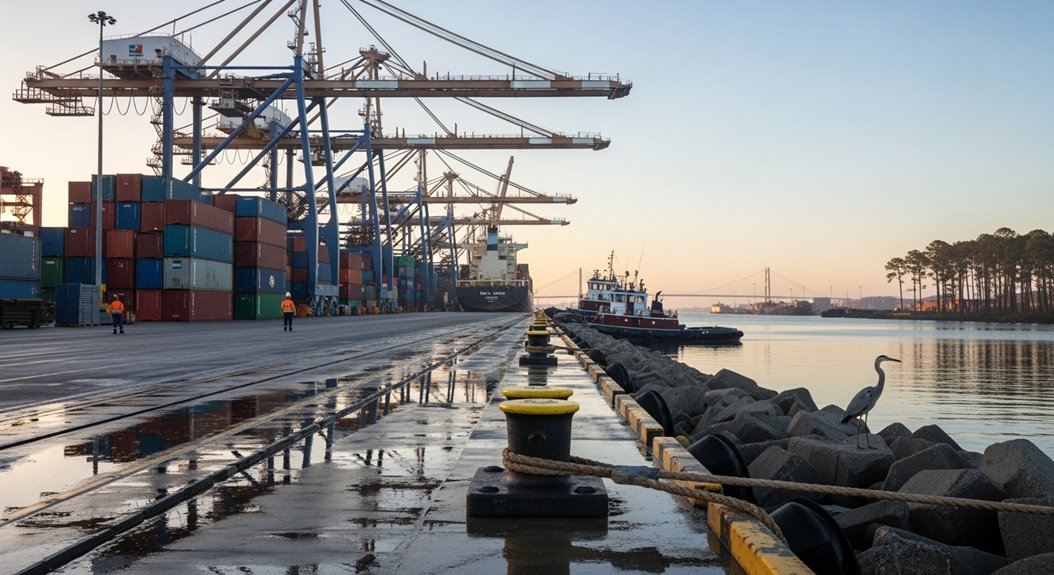
What is LHWCA Coverage?
The Longshore and Harbor Workers’ Compensation Act (LHWCA) provides critical injury benefits and protections to maritime workers who don’t qualify as seamen under the Jones Act. This federal law establishes coverage scope for employees working in maritime occupations on navigable waters or adjoining areas like piers, docks, terminals, and shipyards.
Claimant eligibility extends to longshoremen, harbor workers, ship repairers, and shipbuilders injured during employment. The Act covers medical treatment, disability compensation, vocational rehabilitation, and death benefits. You’re protected whether you work directly on the water or in adjacent maritime facilities essential to loading, unloading, or repairing vessels. In addition, the OWCP and its DLHWC administer claims and benefits under the LHWCA.
Who Qualifies for LHWCA Benefits?
When determining LHWCA eligibility, you must satisfy two distinct requirements: the status test and the situs test. The status test examines your employment role—you can’t be a vessel master, crew member, or small vessel operator. Covered employments include longshoremen, harbor workers, ship repairers, shipbuilders, and shipbreakers. The situs test evaluates your work location—you must work on navigable waters or adjoining areas like piers, docks, terminals, and loading facilities. These eligibility criteria work together, meaning you’ll need to meet both standards.
If your injury occurred while working in maritime commerce on qualifying premises, you likely qualify for benefits. Under the Longshore Act, coverage also extends to injuries on dry docks, shipyards, and marine railways, as well as other adjoining areas customarily used for vessel-related activities.
How Does LHWCA Differ from Other Maritime Laws?
Maritime law contains several distinct legal frameworks, and understanding which one applies to your situation directly impacts your compensation rights and legal options. The LHWCA provides no-fault benefits for injured maritime workers, meaning you don’t need to prove employer negligence. In contrast, the Jones Act requires seamen to demonstrate fault and offers comparative jurisdiction through federal courts. Liability distinctions matter markedly.
While LHWCA limits employer liability but guarantees compensation, the Jones Act allows full damage recovery including pain and suffering. Some workers may qualify under multiple maritime laws, creating strategic considerations for your claim.
Major Ports and Maritime Facilities in Virginia
Norfolk International Terminals
Located in Norfolk, Virginia, Norfolk International Terminals (NIT) serves as one of the Port of Virginia’s flagship facilities on the Elizabeth River. The terminal is operated by Virginia International Terminals (VIT) and handles a diverse range of cargo including containerized goods, breakbulk, and roll-on/roll-off cargo.
Major shipping lines including CMA CGM, Ocean Network Express, and Hapag-Lloyd utilize NIT as a primary East Coast gateway. The facility specializes in container operations with extensive warehousing and distribution capabilities supporting automotive, agriculture, and consumer goods industries.
NIT processes approximately 800,000 TEUs annually and operates with a workforce of over 1,500 employees including longshoremen, equipment operators, and terminal staff. The facility features seven berths with depths up to 50 feet, 26 super post-Panamax cranes, and over 400 acres of container yard space. Recent infrastructure investments exceeding $450 million have enhanced rail connectivity and expanded container handling capacity. The terminal contributes significantly to Virginia’s economy, supporting over 10,000 direct and indirect jobs in the Hampton Roads region.
Virginia International Gateway
Virginia International Gateway (VIG) is situated in Portsmouth along the Southern Branch of the Elizabeth River, representing the Port of Virginia’s most technologically advanced container terminal. Operated by Virginia International Terminals, VIG serves major global carriers and benefits from direct Interstate 664 access and on-dock rail capabilities via CSX and Norfolk Southern.
The facility specializes in high-efficiency container operations serving retailers, manufacturers, and logistics companies with connections throughout the Mid-Atlantic and Midwest regions. VIG handles approximately 1.2 million TEUs annually with a workforce of roughly 1,000 employees. The semi-automated terminal spans 275 acres with 43 automated stacking cranes and eight ship-to-shore cranes capable of servicing ultra-large container vessels.
The facility maintains a 55-foot-deep channel accommodating the world’s largest container ships. Recent expansions totaling $700 million have increased annual capacity to 1.5 million TEUs. VIG generates an estimated $2.3 billion in annual economic impact for Virginia’s economy.
Portsmouth Marine Terminal
Portsmouth Marine Terminal (PMT) operates as a multipurpose facility on the Southern Branch of the Elizabeth River in Portsmouth, Virginia. The terminal is managed by Virginia International Terminals and specializes in breakbulk, project cargo, roll-on/roll-off operations, and forest products.
PMT serves industries including construction equipment, steel, machinery, and paper products, with clients ranging from heavy equipment manufacturers to international forest product exporters. The facility provides critical infrastructure for companies requiring specialized cargo handling beyond standard containerized shipping. PMT handles approximately 150,000 tons of breakbulk and project cargo annually with a workforce of approximately 400 employees. The terminal features five general cargo berths with depths ranging from 38 to 45 feet, heavy-lift cranes with capacities up to 100 tons, and over 100 acres of open storage yard.
Infrastructure improvements totaling $85 million have modernized berth structures and expanded storage capacity. The terminal’s specialized operations contribute an estimated $400 million annually to the regional economy while supporting approximately 2,500 direct and indirect jobs.
Newport News Marine Terminal
Newport News Marine Terminal is located on the James River in Newport News, Virginia, serving as the Port of Virginia’s primary coal export facility. Operated by Virginia International Terminals, the terminal handles bulk commodities including coal, aggregates, and other dry bulk materials.
Major coal producers and commodity traders utilize the facility’s direct rail access from Appalachian coal fields via Norfolk Southern and CSX rail lines. The terminal also supports breakbulk operations and has historically served as a critical energy export gateway for domestic and international markets. The facility exports approximately 15-20 million tons of coal and bulk commodities annually with a workforce of around 300 employees. Newport News Marine Terminal features specialized coal handling equipment including railcar dumpers, conveyor systems, and shiploaders capable of loading vessels at rates exceeding 10,000 tons per hour.
The terminal maintains berths with depths up to 50 feet accommodating Capesize bulk carriers. Despite fluctuations in coal markets, the facility generates approximately $300 million in annual economic activity and supports roughly 1,800 jobs throughout the supply chain.
Craney Island Marine Terminal
Craney Island Marine Terminal serves as a specialized dredge material management facility and future container terminal expansion site in Portsmouth, Virginia. Currently operated by the U.S. Army Corps of Engineers and the Port of Virginia, the 2,500-acre site functions as a confined dredge material disposal facility essential for maintaining navigation channels throughout Hampton Roads. A key federal resource for this work is the USACE’s WCSC navigation facilities dataset, which maps port and waterway infrastructure throughout the region.
The Port of Virginia has designated Craney Island for future terminal development that would significantly expand the port’s container handling capacity. The planned facility will accommodate ultra-large container vessels and include state-of-the-art automation technology. The existing Craney Island operation employs approximately 50 personnel managing dredge material operations. The planned container terminal development represents a $3.5 billion investment that would add capacity for 2 million TEUs annually once completed in phases through 2040.
The project includes construction of six deep-water berths with 55-foot depths, 22 ship-to-shore cranes, and extensive rail infrastructure. Upon completion, the facility is projected to generate over $1 billion in annual economic impact and create approximately 5,000 new direct and indirect jobs in the Hampton Roads region.
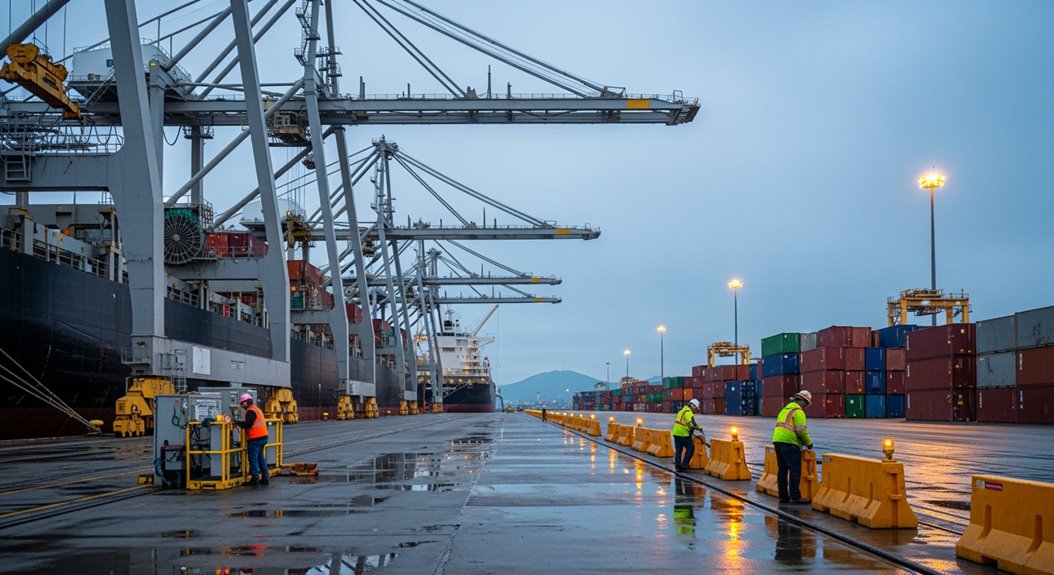
Common Longshore and Dock Worker Accidents in Virginia
Virginia’s busy ports and maritime terminals expose dock workers and longshoremen to numerous serious hazards every day. Despite safety regulations, accidents occur frequently due to equipment malfunctions, inadequate training, poor dock ergonomics, and insufficient fatigue management protocols. OSHA highlights typical longshoring hazards and provides resources on marine terminals to help prevent injuries.
Common accidents include:
- Equipment incidents – Cranes, forklifts, and straddle carriers cause crushing injuries and fatalities
- Slips and falls – Wet surfaces and elevated platforms lead to serious injuries
- Struck-by hazards – Swinging cargo and moving vehicles strike workers
- Confined space dangers – Ship holds present asphyxiation and toxic exposure risks
- Water incidents – Falls overboard can result in drowning
These accidents often result in catastrophic injuries requiring immediate legal protection.
Longshore and Port Worker Injury Statistics in Virginia
Every day, thousands of dock workers, longshoremen, and maritime employees face substantial injury risks across the nation’s ports and harbors. While Virginia statistics align with broader national trends, understanding these numbers helps illustrate the dangers you encounter.
Seasonal trends show increased incidents during peak shipping periods when cargo volume surges and work pace intensifies.
Nationwide maritime injury rates reveal:
- Port operations record 5.3 injuries per 100 workers annually
- Marine cargo handling sees 3.3 cases per 100 workers
- Maritime fatality rates exceed the national average by 4.7 times
- Over 5,000 longshoremen suffer injuries per 100,000 workers
- Vessel incidents cause approximately 1,600 injuries yearly
According to BLS national data, overall private industry experienced incidence rates of roughly 2.7 total recordable cases per 100 full-time workers, underscoring how certain maritime sectors exceed the broader average.
Insurance companies know our reputation. They know we prepare every case for trial and we’ll go the distance when settlement offers fall short. We investigate thoroughly, build bulletproof cases, and aren’t afraid to take yours to court. That changes negotiations from the start.
Anytime. Anywhere. We’re Ready to Fight for You.
Compensation Available for Longshoremen in Virginia
If you've suffered an injury while working in Virginia's ports or shipyards, you're entitled to specific benefits under the Longshore and Harbor Workers' Compensation Act. These benefits can cover your immediate medical needs, replace lost income during your recovery, and provide financial support to your family if your injuries prove fatal. Understanding what compensation you can claim and how to maximize your benefits is critical to securing the full recovery you deserve.
Medical Benefits
Under the Longshore and Harbor Workers' Compensation Act, injured workers are entitled to thorough medical treatment without worrying about out-of-pocket costs. You'll receive coverage for doctor visits, surgeries, medications, physical therapy, and necessary medical equipment. The insurance carrier must approve treatment authorization promptly, though disputes sometimes arise.
Maintaining detailed medical documentation strengthens your claim and guarantees continuity of care. You're entitled to choose your treating physician after the initial evaluation. If the insurance company denies recommended treatment, you can challenge that decision through the administrative process. These benefits continue throughout your recovery period.
Disability Benefits
Beyond covering your medical expenses, the Longshore Act provides wage replacement benefits when your injury prevents you from working. If you're totally disabled and can't return to any employment, you'll receive two-thirds of your average weekly wage.
For partial disability, when you can work but earn less than before, you'll get two-thirds of the difference between your pre-injury and current wages. The insurance carrier may require a functional capacity evaluation to assess your physical abilities. You're also entitled to vocational rehabilitation services if your injury requires you to learn new job skills for different work within your capabilities.
Death Benefits
When a longshore work accident results in a worker's death, the Longshore and Harbor Workers' Compensation Act provides financial support to surviving family members who depended on the deceased worker's income. Survivor compensation typically includes a percentage of the worker's average weekly wages, distributed to eligible dependents such as spouses and children.
The Act also covers funeral expenses up to a specified amount, helping families manage immediate costs during an already difficult time. These death benefits recognize that your loved one's income supported your household, and you shouldn't face financial hardship alongside your grief.
Additional Damages
While the Longshore and Harbor Workers' Compensation Act primarily covers medical expenses, wage replacement, and disability benefits, Virginia longshoremen injured through employer negligence or unsafe working conditions may qualify for additional compensation beyond standard benefits.
You might pursue claims for emotional distress when your injury causes significant psychological harm like anxiety, depression, or trauma. In cases involving particularly reckless employer conduct, punitive damages become possible. These financial penalties punish egregious safety violations and deter future misconduct. Third-party liability claims against equipment manufacturers, contractors, or vessel owners can also provide compensation exceeding traditional LHWCA benefits.
Statute of Limitations for Filing a LHWCA Claim
Time limits for filing your Longshore and Harbor Workers' Compensation Act claim can determine whether you'll receive the benefits you're entitled to or lose your right to compensation entirely.
You must notify your employer of your injury within 30 days and file your formal claim within one year of the accident or from when you became aware of your work-related condition. Missing these filing deadlines typically bars your claim permanently.
However, claim tolling may extend these deadlines under specific circumstances, such as employer fraud or reasonable ignorance of your rights. An experienced Virginia longshore attorney protects your claim timeline.
Get Results
Each one of our lawyers is a skilled and experienced litigator and negotiator. We never recommend settling your case when trial presents a better opportunity for recovery.



Why Do I Need a Longshoremen Workers Comp Injury Lawyer?
Insurance companies handling Longshore and Harbor Workers' Compensation Act claims employ teams of experienced lawyers whose sole job is minimizing what they pay you.
They'll use complex regulations and technical procedures to reduce your benefits. A skilled Longshore attorney levels the playing field through thorough case evaluation that identifies all compensation you're entitled to receive. Your lawyer develops an effective settlement strategy while preparing for trial if insurers won't offer fair payment.
With legal representation, you'll have an advocate who understands maritime law nuances and fights for maximum compensation rather than accepting the insurance company's first low offer.
Why Choose Grossman Attorneys for Your Virginia LHWCA Claim
When you're injured on the job under the LHWCA, choosing the right attorney can make the difference between a quick settlement that falls short and full compensation that covers your future needs.
Grossman Attorneys at Law is a respected maritime law firm with over 40 years of experience representing injured workers across the nation. Our maritime accident lawyers have secured substantial settlements and verdicts in cases ranging from Defense Base Act claims to longshoremen workers' comp injury cases and offshore accidents. We understand the complex laws that govern these claims and stand ready to take your case to trial when insurance companies fail to offer the fair compensation you deserve.
Aggressive But Fair Representation
Standing up to insurance companies and their defense teams requires a law firm that won't back down from a fight. Grossman Attorneys combines assertive advocacy with ethical zeal, pushing hard for maximum compensation while maintaining professional integrity.
You'll never face pressure to accept inadequate settlement offers. The firm's litigation-first approach means preparing every case for trial, which motivates insurers to present fair offers.
Defense attorneys recognize Grossman's courtroom reputation and thorough preparation. This aggressive stance, balanced with honest case assessments and transparent communication, guarantees you receive powerful representation without compromising professional standards or realistic expectations about your claim's value.
Experienced, Compassionate Staff
Behind every successful LHWCA claim stands a team that combines deep legal knowledge with genuine care for injured workers. At Grossman Attorneys, you'll work with professionals trained in trauma informed care who understand the physical and emotional toll of maritime injuries.
Our staff provides empathetic outreach from your first call through final resolution, answering questions patiently and keeping you informed at every stage. We recognize you're navigating unfamiliar legal territory while recovering from injury. That's why our team balances assertive advocacy with compassionate communication, ensuring you feel supported while we fight aggressively for your rightful benefits.
A Track Record of Winning Longshore Claims
Compassionate support matters, but results matter more when your livelihood depends on securing the benefits you've earned. Grossman Attorneys has secured numerous multi-million-dollar settlements for injured maritime workers through strategic negotiation and aggressive litigation.
Our settlement strategies focus on maximizing your compensation while our trial victories demonstrate our willingness to fight when insurers refuse fair offers. Defense attorneys and insurance carriers recognize our thorough case preparation and courtroom capabilities.
With over 40 years of longshore litigation experience, we've built a national reputation by consistently achieving maximum compensation for injured workers facing Fortune 500 companies and major insurers.
Injured at a Virginia Port? Let Grossman Attorneys Fight for Your LHWCA Compensation
If you or a loved one has been injured while working at a Virginia port or maritime facility, you don't have to navigate the complex LHWCA claims process alone. Grossman Attorneys at Law has spent over four decades fighting for injured maritime workers across the United States, securing the maximum compensation our clients deserve.
We recognize the physical, emotional, and financial toll these injuries take on workers and their families. Our litigation-first approach means we're prepared to take your case to trial if insurance carriers refuse to offer fair compensation.
Don't settle for less than you're entitled to under the law. Contact Grossman Attorneys today to speak with an experienced LHWCA attorney who'll fight tirelessly for your rights.
*If you hire Grossman Attorneys for your LHWCA case, you pay no attorney fees for our service. When we win your case, the employer or its insurer typically pays a DOL-approved attorney’s fee and any case expenses we advanced are reimbursed from the recovery. If we don't win, you pay nothing.
- https://vamaritime.com/VirginiaPortsAnnual/VirginiaPortsAnnual/Port-Facilities/Facilities.aspx
- https://www.unisco.com/us-ports/the-port-of-virginia
- https://en.wikipedia.org/wiki/Virginia_Port_Authority
- https://hamptonroadsalliance.com/port-of-virginia/
- https://www.virginia.gov/agencies/virginia-port-authority-/
- https://www.portofvirginia.com
- https://vamaritime.com/VirginiaPortsAnnual/VirginiaPortsAnnual/Port-Facilities/Port_Waterways_Facilities.aspx
- http://www.virginiaplaces.org/transportation/shiptransport.html
- https://www.atlanticarea.uscg.mil/Our-Organization/District-Units/East-District/Sector-Virginia/
- https://dwr.virginia.gov/wp-content/uploads/media/2024-Recreational-Boating-Incident-Summary.pdf