


Top Rated Delaware Longshoreman injury Law Firm – Grossman Attorneys
If you’ve been injured working at a Delaware port, dock, or shipyard, you need more than medical care. You need an attorney who knows federal maritime law inside and out. The Longshore and Harbor Workers’ Compensation Act is complex, and insurance companies use every technicality to reduce or deny your benefits.
At Grossman Attorneys at Law, we’ve spent years helping longshoremen and harbor workers fight for full compensation under the LHWCA. We know how to negotiate aggressively with insurers, and when they refuse to offer fair settlements, we’re prepared to take your case to trial. You’ve given your strength to keep commerce moving. Now let us put our experience to work for you. Call today for a free consultation and learn what your claim is truly worth.
Understanding the Longshore and Harbor Workers’ Compensation Act (LHWCA)
If you’ve been injured while working on Delaware’s docks, harbors, or waterfront facilities, the Longshore and Harbor Workers’ Compensation Act (LHWCA) likely protects you.
This federal law provides specific benefits and protections for maritime workers that differ markedly from standard workers’ compensation and other maritime injury laws like the Jones Act.
Understanding whether you qualify for LHWCA coverage, what benefits you’re entitled to receive, and how this law compares to other options is essential for protecting your rights and securing the compensation you deserve.
Under the LHWCA, employers must secure coverage through private insurance or self-insurance, and a DOL-administered Special Fund provides certain benefits when a responsible employer or insurer cannot pay.

What is LHWCA Coverage?
For workers injured while loading cargo ships, repairing docks, or performing other maritime tasks in Delaware, the Longshore and Harbor Workers’ Compensation Act (LHWCA) provides federal benefits that typically exceed what standard workers’ compensation offers.
The coverage scope extends to longshoremen, harbor workers, ship repairers, shipbuilders, and shipbreakers working on navigable waters or adjacent areas like piers and terminals. Understanding benefit exclusions is essential, as LHWCA doesn’t cover certain workers including masters and crew members of vessels, small vessel operators, marina employees, and office workers.
Independent contractors and volunteers also fall outside LHWCA protection.
Under the LHWCA, covered injuries at dry docks, shipyards, wharves, and other adjoining areas customarily used for vessel-related activities qualify for medical, disability, or death benefits.
Who Qualifies for LHWCA Benefits?
Although the LHWCA extends federal protections to maritime workers, qualification hinges on meeting two distinct tests: the status test and the situs test.
Your employment status must demonstrate you’re a maritime employee rather than a traditional land-based worker. You’ll need to show your injury occurred on or near navigable waters, establishing the proper situs (location). The injury causation must connect directly to your maritime employment duties.
Delaware dock workers, shipbuilders, harbor construction workers, and vessel repair technicians typically satisfy both requirements. Meeting these criteria determines your eligibility for LHWCA compensation benefits rather than standard workers’ compensation coverage. Under the LHWCA, covered employees may receive medical care, wage loss benefits, and vocational rehabilitation overseen by the OWCP/DLHWC.
How Does LHWCA Differ from Other Maritime Laws?
Understanding which maritime law applies to your injury claim isn’t just a technical detail—it determines your entire path to compensation. The LHWCA differs markedly from the Jones Act, which covers seamen with fault-based lawsuits, and general maritime law claims.
Comparative remedies vary considerably: LHWCA provides workers’ compensation-style benefits regardless of fault, while Jones Act claims require proving negligence but offer unlimited damages. Jurisdictional overlap creates complexity, as some workers may qualify under multiple maritime laws.
Delaware maritime workers need attorneys who understand these distinctions to pursue the maximum benefits available under the correct legal framework for their specific employment situation.
Major Ports and Maritime Facilities in Delaware
Port of Wilmington
Located along the Christina River in northern Delaware, the Port of Wilmington serves as the state’s primary deep-water port facility. Major terminal operators include Gulftainer, which manages container operations, along with various petroleum and bulk cargo handlers.
The facility specializes in containerized cargo, fresh fruit imports, automobiles, steel, and petroleum products, serving as a critical distribution hub for the Mid-Atlantic region. The port processes approximately 200,000 containers annually and handles one million tons of petroleum products through nine specialized berths. Thousands of longshore workers are employed across port operations, managing diverse cargo including tropical fruit and petroleum products.
The Edgemoor expansion project represents a significant infrastructure investment that will quadruple the port’s container capacity while creating an estimated 4,000 construction jobs, substantially increasing the port’s economic impact on Delaware’s maritime supply chain. In the broader context of U.S. ports, operations contribute nearly $2.59 trillion to national GDP, with TEU used widely to quantify container traffic in official statistics.
Port of New Castle
Situated along the Delaware River in New Castle County, the Port of New Castle functions as a major petroleum distribution facility serving the Mid-Atlantic region. The port primarily handles bulk liquid cargo operations, with petroleum companies utilizing the facility for storage and distribution throughout regional fuel networks.
The facility processes 9.2 million tons of petroleum products annually, playing a vital role in regional fuel distribution infrastructure. The port’s operations support the steady flow of petroleum products to markets across the Mid-Atlantic, contributing significantly to Delaware’s maritime industry and regional energy supply chains.
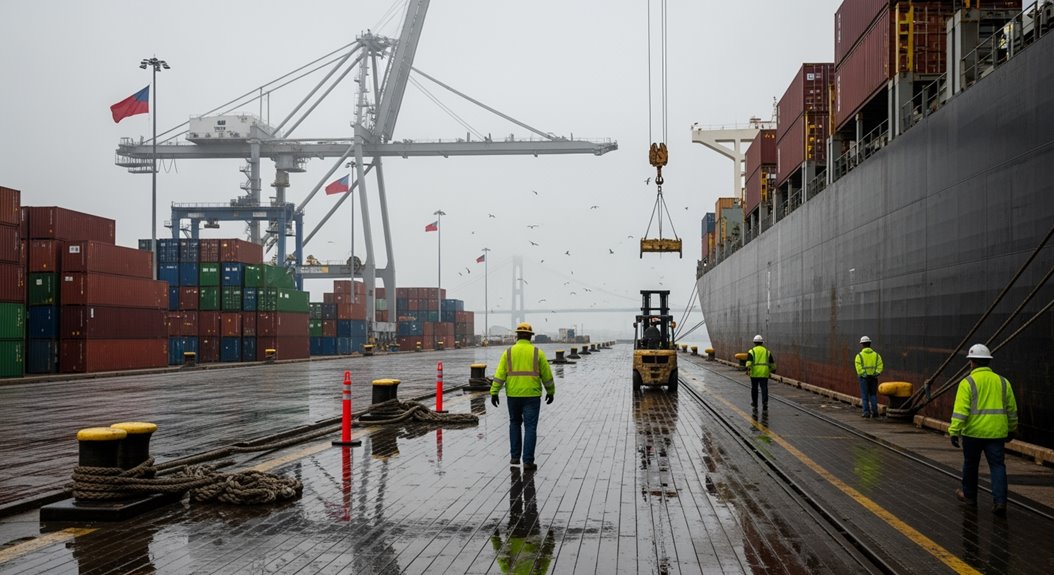
Common Longshore and Dock Worker Accidents in Delaware
Delaware’s maritime facilities expose longshore workers to a complex array of workplace hazards that can result in catastrophic injuries or fatalities. You’ll face risks from multiple sources during daily operations:
- Slip and fall accidents caused by water, oil residue, or inadequate lighting along loading zones
- Struck-by incidents involving cargo containers, forklifts, and cranes during vessel operations
- Hazardous substance exposure from chemical cargoes, fuels, and diesel exhaust
Poor dock ergonomics and insufficient crew training markedly increase these dangers. Equipment malfunctions, vehicle collisions, and caught-in accidents between machinery remain persistent threats. Understanding these hazards helps you recognize when employer negligence contributes to your injury.
OSHA highlights additional longshoring hazards such as cargo handling risks, falling objects, and unsafe stacking practices, and provides guidance and resources to prevent injuries at marine terminals.
Longshore and Port Worker Injury Statistics in Delaware
Across Delaware’s ports and maritime facilities, workplace injuries occur at rates that markedly exceed state averages, placing longshore workers among the most vulnerable employment sectors. The trade, transportation, and utilities sector recorded 3.5 cases per 100 full-time workers in 2023, notably higher than Delaware’s overall rate of 2.2. According to BLS national data, the incidence rates for trade, transportation, and utilities consistently rank among the higher industry sectors compared to many others.
Several factors contribute to elevated injury rates:
- Worker turnover increased dramatically, with new hires rising from 36% to 44% between 2019 and 2022
- Shift patterns and extended hours create fatigue-related hazards
- Temporary disability duration extended from 12.6 to 15.3 weeks for workers with less than one year tenure
These statistics underscore the serious risks you face daily.
Insurance companies know our reputation. They know we prepare every case for trial and we’ll go the distance when settlement offers fall short. We investigate thoroughly, build bulletproof cases, and aren’t afraid to take yours to court. That changes negotiations from the start.
Anytime. Anywhere. We’re Ready to Fight for You.
Compensation Available for Longshoremen in Delaware
If you've suffered a workplace injury as a longshoreman in Delaware, the Longshore and Harbor Workers' Compensation Act (LHWCA) provides several types of financial protection to help you recover and support your family.
These benefits go beyond basic workers' compensation, offering all-encompassing coverage for medical expenses, lost income, and long-term disability needs. Understanding what compensation you're entitled to can help you pursue the full recovery you deserve after a maritime workplace accident.
Medical Benefits
Understanding your medical rights after a longshore injury can make the difference between receiving adequate treatment and struggling with denied claims.
Under the Longshore Act, you're entitled to all reasonable and necessary medical care related to your work injury. This includes doctor visits, surgeries, medications, physical therapy, and specialized treatments.
Injured longshoremen benefit from medical networking and treatment coordination through experienced attorneys who make certain you see qualified providers familiar with maritime injuries.
Insurance carriers can't force you to accept inadequate care. Your attorney will protect your access to proper treatment while handling the complex approval processes that often delay critical medical services.
Disability Benefits
When your longshore injury prevents you from working, disability benefits provide wage replacement based on the severity of your condition and how it affects your earning capacity.
The Longshore Act provides temporary total disability benefits while you're completely unable to work, temporary partial benefits when you can perform limited duties at reduced wages, and permanent disability benefits for lasting impairments. Your compensation equals two-thirds of your average weekly wage, subject to statutory maximums.
These benefits differ from social security disability payments and may include vocational rehabilitation services to help you return to suitable employment when medically appropriate.
Death Benefits
Although nothing can truly compensate for the loss of a family member, the Longshore and Harbor Workers' Compensation Act provides death benefits to help surviving dependents manage the financial impact of a fatal workplace injury.
You'll receive survivor benefits equal to two-thirds of your loved one's average weekly wage, distributed among eligible family members. The Act also covers funeral expenses up to $3,000. These benefits continue until dependent children reach age 18, or age 23 if they're full-time students.
Surviving spouses may receive benefits for life or until remarriage, when they'll receive a lump-sum payment.
Additional Damages
Beyond the standard Longshore Act benefits covering medical treatment and lost wages, injured maritime workers in Delaware may pursue additional compensation through third-party liability claims. When equipment manufacturers, vessel owners, or contractors cause your injuries through negligence, you can file separate lawsuits against these parties.
These claims may include compensation for pain and suffering, emotional distress, and reduced quality of life—damages unavailable under the Longshore Act alone. In cases involving egregious misconduct, courts may award punitive remedies designed to punish wrongdoers and deter future negligence. Our attorneys identify all potential sources of compensation to maximize your recovery.
Statute of Limitations for Filing a LHWCA Claim
Time limits matter critically in Longshore and Harbor Workers' Compensation Act cases, and missing a filing deadline can destroy an otherwise valid claim.
You typically have one year from your injury date to provide written notice to your employer. The statute of limitations for filing a formal claim is also one year, though claim tolling—the legal pause of deadlines under certain circumstances, may apply if your employer had actual knowledge of your injury.
Delaware longshore workers must understand these filing deadlines aren't merely suggestions. Missing them often means losing your right to compensation permanently, regardless of your injury's severity.
Get Results
Each one of our lawyers is a skilled and experienced litigator and negotiator. We never recommend settling your case when trial presents a better opportunity for recovery.



Why Do I Need a Longshoremen Workers Comp Injury Lawyer?
While you're legally permitted to handle a LHWCA claim without representation, maritime injury cases involve complex federal regulations that even experienced personal injury attorneys often don't understand.
A specialized longshore lawyer knows how to counter insurance company tactics designed to minimize your benefits. They'll handle medical advocacy, ensuring you receive appropriate treatment from approved physicians while documenting your injuries properly.
During settlement negotiation, they'll calculate the full value of your claim, including future medical costs and wage losses that adjusters typically undervalue. Without proper representation, you risk accepting compensation that falls short of what you're entitled to receive.
Why Choose Grossman Attorneys for Your Delaware LHWCA Claim
When you're facing a Longshore and Harbor Workers' Compensation Act claim in Delaware, you need attorneys who won't back down from insurance companies or their lawyers.
Grossman Attorneys at Law is a respected maritime law firm with over 40 years of experience representing injured workers across the nation. Our maritime attorneys have secured substantial settlements and verdicts in cases ranging from Defense Base Act claims to longshoremen workers' comp injury cases and offshore accidents. We understand the complex laws that govern these claims and stand ready to take your case to trial when insurance companies fail to offer the fair compensation you deserve.
Aggressive But Fair Representation
Because insurance companies respect strength backed by preparation, Grossman Attorneys at Law has built a reputation that changes how your case gets handled from day one.
Our zealous advocacy means we'll fight relentlessly for every dollar you deserve, while our commitment to ethical negotiation guarantees we achieve results through skill and preparation rather than empty threats.
Defense attorneys know we're fully prepared to take your case to trial if they won't offer fair compensation. This reputation often leads to better settlement offers because carriers understand we won't accept inadequate amounts just to close your file quickly.
Experienced, Compassionate Staff
Aggressive representation means nothing without the human touch that helps injured workers navigate one of the most challenging periods of their lives.
Our experienced counselors understand that behind every case file is a person facing medical bills, lost wages, and uncertainty about their future. From your initial call forward, you'll work with compassionate intake specialists who listen without rushing and explain complex legal processes in straightforward terms.
We've guided thousands of maritime workers through LHWCA claims, and we recognize that clear communication and genuine support matter just as much as courtroom victories.
A Track Record of Winning Longshore Claims
Results speak louder than promises when your livelihood hangs in the balance. Grossman Attorneys has secured numerous multi-million-dollar settlements for injured maritime workers nationwide. Our settlement strategies focus on maximizing your compensation, not rushing you toward inadequate offers.
Defense attorneys and insurance carriers know we're prepared to litigate aggressively when fair settlements aren't offered. Our trial success stems from thorough case preparation and refusing to back down. With over 40 years specializing in Longshore claims, we've built a reputation that works in your favor before we even enter the courtroom. Your case deserves this level of commitment.
Injured at a Delaware Port? Let Grossman Attorneys Fight for Your LHWCA Compensation
If you or a loved one has suffered an injury while working at a Delaware port or maritime facility, you don't have to face the complex LHWCA claims process alone.
Grossman Attorneys at Law has over 40 years of experience fighting for injured maritime workers nationwide, and we're ready to put that expertise to work for you. We recognize the physical, emotional, and financial toll these injuries take on workers and their families. Our litigation-first approach means we won't settle for less than you deserve—we're prepared to take your case to trial if necessary. Don't let insurance companies minimize your claim.
Contact Grossman Attorneys today to speak with an experienced LHWCA attorney who'll fight relentlessly for your maximum compensation.
*If you hire Grossman Attorneys for your LHWCA case, you pay no attorney fees for our service. When we win your case, the employer or its insurer typically pays a DOL-approved attorney’s fee and any case expenses we advanced are reimbursed from the recovery. If we don't win, you pay nothing.
- https://www.dvrpc.org/webmaps/phillyfreightfinder/modals/port.html
- https://en.wikipedia.org/wiki/Port_of_Wilmington_(Delaware)
- https://roa.midatlanticocean.org/ocean-uses/status-trends-and-linkages/maritime-commerce-and-navigation/
- https://wilmapco.org/freight/freightplan/Ports.pdf
- https://portwilmington.com/strategic-location/
- https://nauticalcharts.noaa.gov/publications/coast-pilot/files/cp3/CPB3_C06_WEB.pdf
- https://www.marinelog.com/news/new-state-of-the-art-port-delaware-is-in-the-works/
- https://www.choosedelaware.com/blog/port-expansion-on-local-and-regional-delaware-economy/
- https://dsp.delaware.gov/wp-content/uploads/sites/118/2022/04/2021-Annual-Traffic-Statistical-Report.pdf