


Top Rated Georgia Longshoreman injury Law Firm – Grossman Attorneys
If you were injured working on the docks in Savannah, Brunswick, or any Georgia port, you already know how quickly everything can change. One accident can leave you facing medical bills, lost wages, and uncertainty about your future while navigating the complicated Longshore and Harbor Workers’ Compensation Act. Insurance companies know this federal system inside and out, and they use that knowledge to minimize what they pay you.
Grossman Attorneys at Law has spent years mastering LHWCA claims for injured maritime workers. We know how to build strong cases, negotiate aggressively with insurers, and take your case to trial when they refuse to offer fair compensation. You did not choose to get hurt on the job, and you should not have to fight this battle alone.
Call us today for a free consultation and let us help you get the benefits you deserve.
Understanding the Longshore and Harbor Workers’ Compensation Act (LHWCA)
If you’ve been injured while working on Georgia’s docks, shipyards, or harbor facilities, you’re likely covered under a federal law called the Longshore and Harbor Workers’ Compensation Act (LHWCA).
This specialized law provides benefits and protections specifically designed for maritime workers who don’t qualify as traditional seamen but work in maritime environments.
Understanding how LHWCA coverage applies to your situation, who qualifies for benefits, and how it differs from other maritime laws is essential to securing the full compensation you deserve after a workplace injury.
Under the LHWCA, eligible workers receive medical care at no cost and disability compensation based on their pre-injury wages, with annual adjustments tied to the National Average Weekly Wage.

What is LHWCA Coverage?
When you work on navigable waters or in adjoining areas where ships load and unload cargo, your workplace injuries fall under a specialized federal law rather than standard workers’ compensation. The LHWCA provides benefits including medical treatment, wage replacement, and disability compensation.
Coverage specifics depend on your work location and job duties. You’re typically covered if you’re injured on docks, piers, terminals, or harbor facilities during loading, unloading, building, or repairing vessels.
Claim eligibility extends to longshoremen, harbor workers, ship repairers, and shipbuilders. However, seamen working aboard vessels generally aren’t covered under this act. The LHWCA also provides death benefits to families when an employee’s death results from a covered injury.
Who Qualifies for LHWCA Benefits?
Your eligibility for LHWCA benefits hinges on two key factors: where you work and what you do there. The eligibility criteria require that your injury occurred on navigable waters or in adjoining areas used for maritime activities. Covered locations include docks, piers, terminals, shipyards, and vessel repair facilities throughout Georgia’s ports in Savannah and Brunswick.
You’ll qualify if you’re involved in loading, unloading, building, or repairing vessels. Harbor workers, longshoremen, ship repairers, and marine construction workers typically meet these requirements. Your specific job duties and injury location determine your qualification for compensation benefits.
You also have the right to choose your own treating doctor under the LHWCA, though changing doctors later generally requires permission from the employer, insurer, or OWCP, as outlined by the Choice of Treating Physician.
How Does LHWCA Differ from Other Maritime Laws?
Although maritime law covers everyone working on or near the water, different statutes provide different protections depending on your specific role and work location. The LHWCA provides no-fault workers’ compensation benefits to land-based maritime workers, while the Jones Act allows seamen to sue employers for negligence.
Understanding comparative jurisdiction, which law applies to your situation, is critical because it affects your available remedies. Benefit interplay becomes important when multiple maritime laws might cover your injury. You can’t receive duplicate benefits, but you may pursue claims under different statutes.
We’ll help determine which law maximizes your compensation.
Major Ports and Maritime Facilities in Georgia
Port of Savannah
Located in Chatham County along the Savannah River approximately 18 miles from the Atlantic Ocean, the Port of Savannah serves as Georgia’s primary container gateway. The Georgia Ports Authority operates this facility, with major terminal operators and shipping lines including Ocean Network Express, CMA CGM, Hapag-Lloyd, and Maersk utilizing the port for trans-Atlantic and global trade routes. The port specializes in containerized cargo handling, serving distribution networks for retail, manufacturing, and automotive sectors throughout the Southeast and Midwest United States.
The port handled 5.25 million twenty-foot equivalent container units (TEUs) in 2024, maintaining its position as the third-busiest container port in the United States. The Garden City Terminal encompasses 1,345 acres of operating space equipped with 36 ship-to-shore container cranes. The facility directly and indirectly supports over 496,700 jobs throughout Georgia and contributes approximately $67 billion annually to the state’s economy. Recent infrastructure investments exceed $4 billion, including berth expansions, rail improvements, and equipment modernization to accommodate larger vessels and increased cargo volumes. Insights from the U.S. Port Performance report place Savannah’s activity within national port efficiency and throughput benchmarks.
Port of Brunswick
Situated in Glynn County along the East River and Turtle River approximately 70 miles south of Savannah, the Port of Brunswick operates as one of the nation’s premier Roll-on/Roll-off (Ro-Ro) cargo facilities. Also operated by the Georgia Ports Authority, the port serves major automotive manufacturers and heavy machinery companies including Hyundai, Kia, Mercedes-Benz, Jaguar Land Rover, and various equipment manufacturers. The facility specializes in automotive and high-and-heavy cargo operations with breakbulk capabilities.
The port spans 1,700 acres and processed over 750,000 vehicle units in recent years, ranking as one of the top automotive ports in North America. Colonel’s Island Terminal and East River Terminal provide specialized vehicle processing and storage facilities. The port supports approximately 1,500 direct jobs and generates significant economic impact for coastal Georgia’s economy. Infrastructure includes modern vessel berths, extensive vehicle storage yards, and processing facilities that serve both import and export automotive markets.
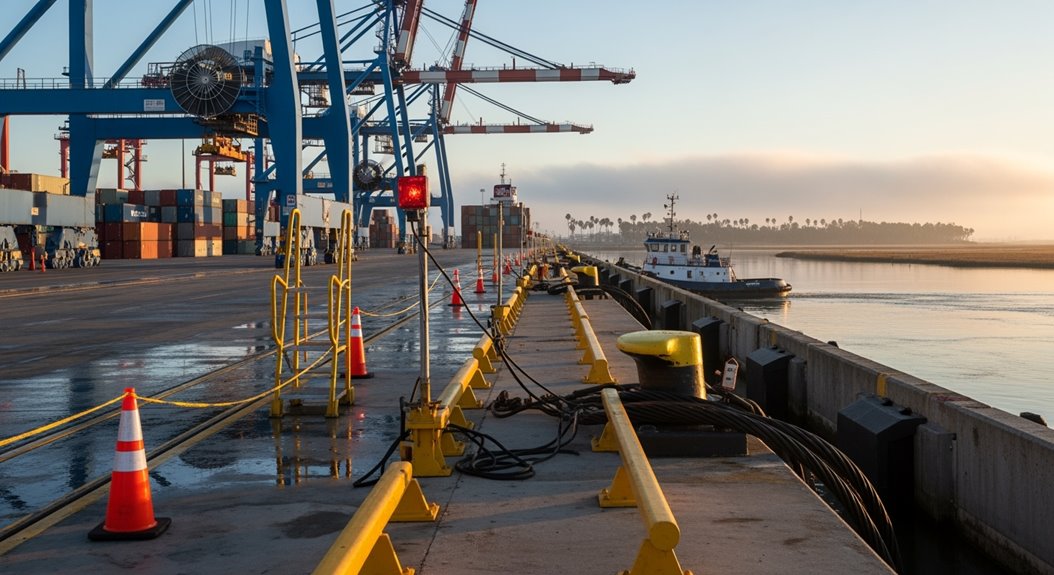
Common Longshore and Dock Worker Accidents in Georgia
Working at Georgia’s busy maritime facilities exposes dock workers and longshoremen to hazards that can cause devastating injuries in seconds.
Transportation incidents represent over 40% of fatal workplace injuries, while falls account for another 16%. These accidents often stem from inadequate equipment maintenance or rushed operations during peak cargo periods. According to BLS data, overall nonfatal injury incidence rates vary by industry, as shown in BLS Table 1, underscoring how certain sectors face higher risks.
Common accident types include:
- Struck-by incidents involving forklifts, cranes, and container handling equipment
- Slip and fall accidents on wet dock surfaces, faulty ladders, or during bridge inspections
- Exposure injuries from hazardous chemicals, extreme heat, or toxic fumes in confined spaces
Poor visibility and crowded conditions amplify these risks markedly.
Longshore and Port Worker Injury Statistics in Georgia
Every year, thousands of maritime workers across the nation suffer serious injuries on the job, and Georgia’s bustling ports contribute substantially to these numbers.
National longshore injury rates reveal alarming port safety concerns:
- Longshore workers face injury rates of 5,000 per 100,000 annually, nearly double the private industry average
- Maritime workers experience fatal injury rates six times higher than general U.S. workers
- Musculoskeletal injuries account for 28% of serious workplace accidents
Worker demographics show older employees and minority workers face disproportionately higher risks.
These statistics likely underrepresent actual injury numbers, as significant underreporting occurs throughout the industry.
OSHA highlights common terminal hazards such as struck-by incidents, fall risks, and cargo handling dangers, emphasizing targeted safety programs and training for longshoring operations.
Insurance companies know our reputation. They know we prepare every case for trial and we’ll go the distance when settlement offers fall short. We investigate thoroughly, build bulletproof cases, and aren’t afraid to take yours to court. That changes negotiations from the start.
Anytime. Anywhere. We’re Ready to Fight for You.
Compensation Available for Longshoremen in Georgia
If you've suffered an injury while working as a longshoreman in Georgia, the Longshore and Harbor Workers' Compensation Act provides several categories of benefits designed to address both your immediate and long-term needs.
Understanding what compensation you're entitled to helps you evaluate whether an insurance company's settlement offer truly covers your losses.
These benefits include coverage for your medical treatment, payments to replace lost wages during your recovery, support for your family if the worst happens, and potentially additional damages in certain circumstances.
Medical Benefits
When you're injured on the job as a longshoreman in Georgia, the Longshore and Harbor Workers' Compensation Act requires your employer's insurance carrier to cover all reasonable and necessary medical treatment related to your work injury. This includes doctor visits, surgery, hospital stays, prescription medications, physical therapy, and medical equipment.
However, insurance carriers often create treatment delays or initiate billing disputes to minimize their costs. You're entitled to choose your own treating physician, and the carrier can't force you to use their doctors. If coverage disputes arise, you have the right to challenge these denials through formal administrative proceedings.
Disability Benefits
Beyond covering your medical expenses, the Longshore Act provides wage replacement benefits when your injuries prevent you from working.
You'll receive two-thirds of your average weekly wage during your recovery period. If your injuries result in permanent disability, you're entitled to ongoing compensation based on the severity of your impairment. The program may also provide vocational rehabilitation services to help you return to suitable employment when possible.
These benefits operate separately from Social Security disability, meaning you can potentially receive both forms of compensation simultaneously. Understanding which benefits apply to your specific situation requires careful evaluation of your circumstances.
Death Benefits
The Longshore and Harbor Workers' Compensation Act provides financial protection for families who've lost a loved one in a work-related accident.
When a longshoreman dies from work injuries, their spouse and dependent children qualify for survivor benefits. These payments typically equal two-thirds of the worker's average weekly wage, distributed among eligible family members. The Act also covers funeral reimbursement up to $3,000 to help with burial expenses.
If you've lost a family member in a maritime workplace accident, you shouldn't navigate these complex claims alone. Grossman Attorneys at Law helps surviving families secure every benefit they're entitled to receive.
Additional Damages
Although Longshore Act benefits cover medical expenses and lost wages, injured Georgia longshoremen often don't realize they may qualify for compensation beyond these standard benefits.
If your employer's actions were particularly reckless or intentional, you might pursue punitive awards—financial penalties designed to punish wrongdoing and deter future misconduct. Additionally, severe injuries causing psychological harm may warrant compensation for emotional distress, including anxiety, depression, or post-traumatic stress resulting from your accident.
These additional damages require proving your employer's conduct exceeded ordinary negligence. Our firm evaluates every case for potential supplemental compensation beyond basic Longshore benefits.
Statute of Limitations for Filing a LHWCA Claim
When you're injured on the job as a longshore or maritime worker, time becomes a critical factor in protecting your right to compensation. The LHWCA imposes strict filing deadlines that can permanently bar your claim if missed.
You must notify your employer within 30 days of your injury and file your formal claim within one year. Certain circumstances allow claim tolling, which pauses these deadlines temporarily.
Missing these deadlines often means losing your benefits entirely, regardless of your injury's severity. Understanding and meeting these timeframes safeguards your legal rights and ensures you receive deserved compensation.
Get Results
Each one of our lawyers is a skilled and experienced litigator and negotiator. We never recommend settling your case when trial presents a better opportunity for recovery.



Why Do I Need a Longshoremen Workers Comp Injury Lawyer?
Managing LHWCA claims without experienced legal representation puts you at a significant disadvantage against insurance companies and employers who've teams of attorneys protecting their interests.
A specialized longshore attorney develops a comprehensive claims strategy tailored to maximize your compensation while protecting your rights throughout the process. Their legal advocacy guarantees insurance carriers don't minimize your injuries or pressure you into inadequate settlements. They handle complex medical documentation, navigate strict federal procedures, and challenge benefit denials effectively. Most importantly, your attorney levels the playing field against well-resourced opposition focused on reducing payouts rather than assuring fair compensation for your injuries.
Why Choose Grossman Attorneys for Your Georgia LHWCA Claim
When you're navigating a Georgia LHWCA claim, you need attorneys who'll fight aggressively for full compensation while treating you with the respect and compassion you deserve.
Grossman Attorneys at Law is a respected maritime law firm with over 40 years of experience representing injured workers across the nation. Our maritime lawyers have secured substantial settlements and verdicts in cases ranging from Defense Base Act claims to longshoremen workers' comp injury cases and offshore accidents. We understand the complex laws that govern these claims and stand ready to take your case to trial when insurance companies fail to offer the fair compensation you deserve.
Aggressive But Fair Representation
Standing up to insurance companies and defense attorneys requires a law firm that won't back down from a fight. Grossman Attorneys combines aggressive negotiation tactics with an unwavering commitment to securing fair settlement offers that reflect your injuries' true impact.
When insurers propose inadequate compensation, we're prepared to take your case to trial. Our litigation-first approach sends a clear message to opposing counsel: we've thoroughly prepared your case for court. This reputation for courtroom readiness often motivates insurance carriers to present reasonable offers during negotiations, knowing we won't accept less than you deserve.
Experienced, Compassionate Staff
Throughout your Georgia longshore injury claim, you'll work with legal professionals who genuinely understand the physical, financial, and emotional challenges you're facing. Our team empathy extends beyond legal knowledge to recognize how injuries disrupt your livelihood and family stability.
We provide all-encompassing support coordination, connecting you with medical specialists, arranging independent medical examinations, and managing documentation throughout your case. Each staff member brings extensive maritime law experience while maintaining accessibility when you need guidance. You'll receive straightforward answers to questions, regular case updates, and responsive communication.
We're committed to reducing your stress while maximizing your compensation and benefits under the LHWCA.
A Track Record of Winning Longshore Claims
Results speak louder than promises when you're selecting legal representation for your LHWCA claim. Our firm has secured numerous multi-million-dollar settlements for injured maritime workers throughout Georgia and nationwide.
Our Trial Successes demonstrate our willingness to litigate cases fully when insurance carriers offer inadequate compensation. Defense attorneys recognize our thorough preparation and courtroom commitment.
Our Settlement Strategies balance aggressive negotiation with strategic litigation, ensuring you receive maximum compensation whether through settlement or verdict. With over 40 years of maritime law experience, we've built our reputation on refusing lowball offers and delivering results that reflect your claim's true value.
Injured at a Georgia Port? Let Grossman Attorneys Fight for Your LHWCA Compensation
If you or a loved one suffered an injury while working at a Georgia port or harbor facility, you don't have to navigate the complex LHWCA claims process alone.
Grossman Attorneys at Law has spent over four decades fighting for maritime workers' rights, securing multi-million-dollar settlements and verdicts against major insurance carriers and Fortune 500 companies. Our litigation-first approach means we're prepared to take your case to trial if insurers refuse to offer full and fair compensation.
Defense attorneys know our reputation for thorough preparation and aggressive advocacy. Don't settle for less than you deserve. Contact Grossman Attorneys today to speak with an experienced LHWCA attorney who'll fight tirelessly for your maximum compensation.
*If you hire Grossman Attorneys for your LHWCA case, you pay no attorney fees for our service. When we win your case, the employer or its insurer typically pays a DOL-approved attorney’s fee and any case expenses we advanced are reimbursed from the recovery. If we don't win, you pay nothing.
- https://www.locationgeorgia.com/advantages/logistics/ports/
- https://en.wikipedia.org/wiki/Port_of_Savannah
- https://www.georgiatrend.com/2024/10/31/georgia-ports-on-the-world-stage/
- https://seda.org/do-business-here/infrastructure/
- https://en.wikipedia.org/wiki/Georgia_Ports_Authority
- https://atlasrea.com/80-years-of-georgia-ports/
- https://gaports.com/facilities/port-of-savannah/
- https://www.maritime.dot.gov/data-reports/ports/list
- https://www.bls.gov/regions/southeast/news-release/2024/fatalworkinjuries_georgia_20240216.htm