


Top Rated Maryland Longshoreman injury Law Firm – Grossman Attorneys
If you were injured loading cargo at the Port of Baltimore or working along Maryland’s waterfront, you need to understand that standard workers’ compensation won’t cover you. As a longshoreman or harbor worker, you’re protected under the federal Longshore and Harbor Workers’ Compensation Act, a specialized system that requires attorneys who truly know its complexities.
Grossman Attorneys at Law has extensive experience handling LHWCA claims for injured maritime workers throughout Maryland. We’ve secured strong results by aggressively negotiating with insurance companies that often try to minimize what they owe injured workers. When fair settlement isn’t possible, we’re fully prepared to take your case to trial.
We know how devastating a serious workplace injury can be for you and your family. You deserve an attorney who will fight for every dollar of compensation available under federal law. Contact Grossman Attorneys at Law today for a free consultation about your longshore injury claim.
Understanding the Longshore and Harbor Workers’ Compensation Act (LHWCA)
If you’ve been injured while working on Maryland’s docks, shipyards, or waterfront facilities, the Longshore and Harbor Workers’ Compensation Act (LHWCA) likely provides your pathway to benefits and compensation. This federal law covers specific categories of maritime workers who don’t qualify as seamen under the Jones Act, creating a distinct legal framework with its own rules and procedures.
Understanding whether you’re covered under LHWCA, what benefits you can receive, and how this law differs from other maritime protections is essential to protecting your rights after a workplace injury. Under the LHWCA, employers must secure coverage through private insurance or self-insurance, and most benefits are delivered by insurers rather than paid directly by the federal government.
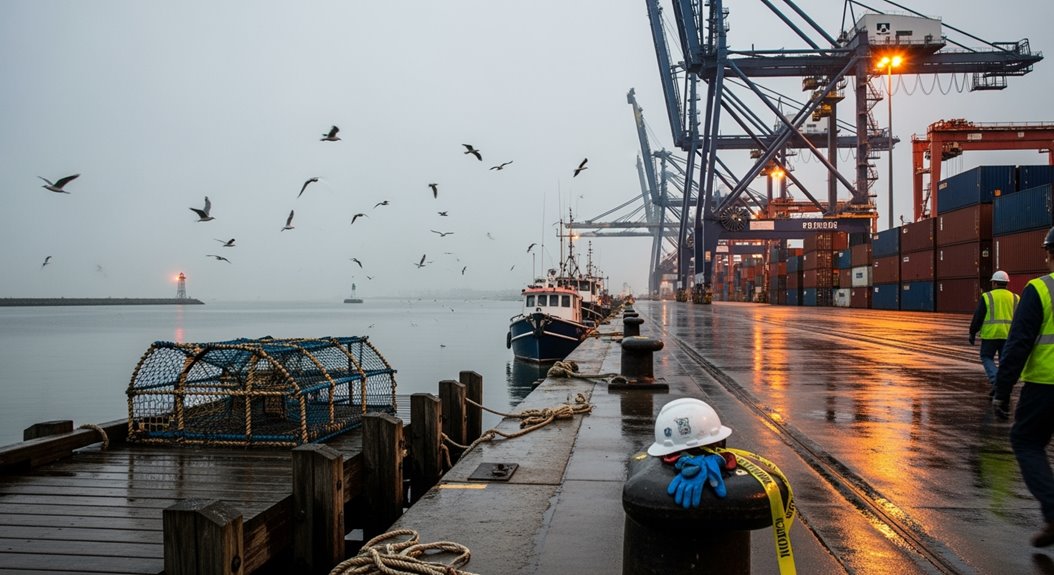
What is LHWCA Coverage?
When you work on navigable waters or in adjacent shore areas, the Longshore and Harbor Workers’ Compensation Act (LHWCA) provides federal protection that’s distinct from typical workers’ compensation. This coverage scope extends to dock workers, ship repairers, harbor construction workers, and others involved in maritime commerce.
The law guarantees medical benefits, wage replacement, and disability compensation when you’re injured on the job. However, statutory exclusions apply to certain workers, including crew members covered under the Jones Act, office personnel, and recreational marina employees.
Understanding whether you qualify requires careful analysis of your work location and duties. Under the LHWCA, injuries at covered sites such as piers, wharves, docks, dry docks, terminals, shipyards, and adjoining areas used for loading, unloading, repairing, dismantling, or building vessels are eligible for benefits.
Who Qualifies for LHWCA Benefits?
Qualifying for LHWCA benefits depends on satisfying two distinct tests: the status test and the situs test. The status test requires you to work as a maritime employee, not a vessel crew member or master.
The situs test demands your injury occurred on navigable waters or in an adjoining area used for maritime activities like loading, unloading, or ship repair. Meeting both eligibility criteria establishes your right to compensation. Once qualified, the benefits timeline begins when you report your injury and file your claim, triggering medical coverage and wage replacement.
Administration of LHWCA benefits is handled by the OWCP’s DLHWC, which oversees claims processing and helps ensure eligible workers receive medical and wage loss benefits.
How Does LHWCA Differ from Other Maritime Laws?
The LHWCA operates as a workers’ compensation system designed exclusively for maritime workers who don’t qualify as seamen, while the Jones Act covers vessel crew members and provides fault-based recovery options.
Understanding maritime jurisdiction matters because it determines which law applies to your case and the compensation you’ll receive. Under LHWCA, you don’t need to prove employer liability to recover benefits, you simply need to show your injury occurred during employment. This no-fault system provides medical benefits and wage replacement. In contrast, Jones Act claims require proving negligence, though they often yield higher compensation when successful.
Major Ports and Maritime Facilities in Maryland
Port of Baltimore
Located along the Patapsco River in central Maryland, the Port of Baltimore serves as the nation’s 10th largest port by total tonnage and operates as the busiest automotive gateway in the United States.
The port encompasses six major terminals spanning 3,405 waterfront acres, with key facilities including Seagirt Marine Terminal specializing in containerized cargo operations and Dundalk Marine Terminal handling breakbulk operations.
The facility processes diverse cargo types ranging from automobiles to hazardous materials and containerized goods. Its strategic position on the Chesapeake Bay provides efficient distribution channels to Midwest manufacturing centers. The Port of Baltimore supports approximately 40,000 jobs annually and has experienced significant growth, with container cargo volumes increasing 92% since 1998.
The port’s extensive infrastructure and Chesapeake connectivity enable high-volume maritime operations that generate substantial economic impact for the region. The facility’s operational scale and cargo diversity create a complex work environment where thousands of maritime workers are employed across stevedoring, cargo handling, vessel operations, and terminal management activities.
Using BEA RIMS II multipliers, analysts can quantify how port activity translates into total regional output, employment, and earnings impacts across Maryland’s economy.
Common Longshore and Dock Worker Accidents in Maryland
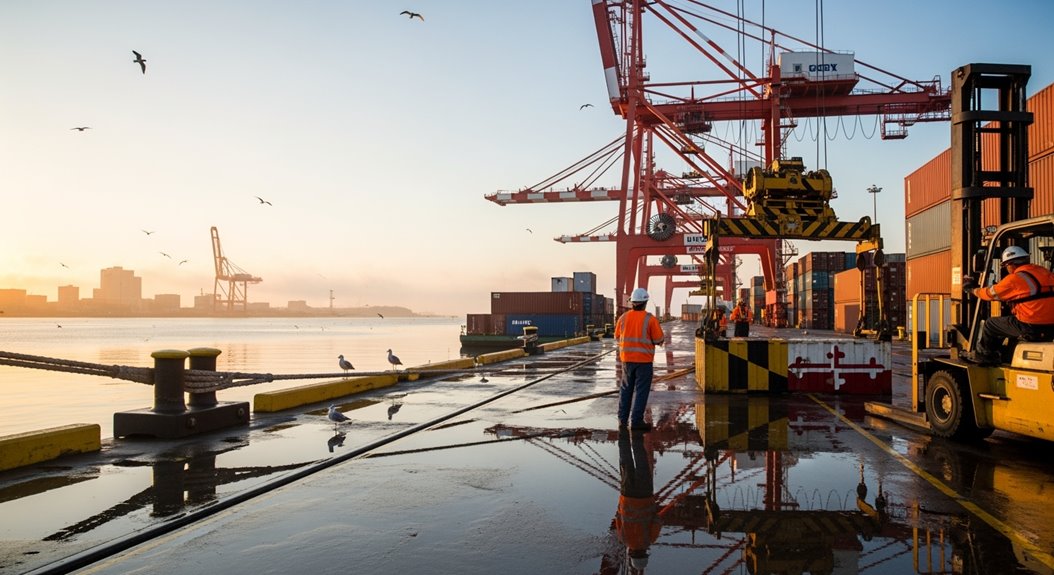
Maryland’s maritime industry creates numerous hazards that put longshore workers and dock employees at risk every single day. You face dangers from slippery surfaces caused by water, oil, and chemical spills across vessel decks and pier structures. Poor dock safety standards and inadequate cargo ergonomics during loading operations increase your injury risks markedly.
Common accidents you might encounter include:
- Equipment failures during crane operations that drop cargo without warning
- Chemical exposure from toxic materials leaking in confined engine room spaces
- Electrocution hazards from faulty wiring systems at terminal facilities
Weather conditions and unseaworthy vessels compound these workplace dangers throughout Maryland’s extensive shoreline. OSHA highlights hazards like falls, struck-by incidents, and chemical exposures in longshoring safety resources that can help terminals and workers identify and mitigate these risks.
Longshore and Port Worker Injury Statistics in Maryland
Working in Maryland’s maritime industry means facing serious risks every day, and the statistics tell a sobering story about just how dangerous these jobs can be. Maryland recorded 80 workplace fatalities in 2022, with transportation and warehousing sectors seeing significant port fatalities. The numbers reveal troubling trends:
- Maritime workers face fatality rates 4.7 times higher than the national average
- Waterfront assaults and workplace violence claimed 22 Maryland workers’ lives in 2022
- Approximately 98,000 longshoring workers nationwide face injury rates of 17.2 per 100,000 employees
These statistics represent real people whose families deserve full compensation under the Longshore and Harbor Workers’ Compensation Act. According to national BLS data, industries vary widely in nonfatal injury incidence, and the overall incidence rates help contextualize maritime workers’ elevated risks.
Insurance companies know our reputation. They know we prepare every case for trial and we’ll go the distance when settlement offers fall short. We investigate thoroughly, build bulletproof cases, and aren’t afraid to take yours to court. That changes negotiations from the start.
Anytime. Anywhere. We’re Ready to Fight for You.
Compensation Available for Longshoremen in Maryland
If you've been injured while working at a Maryland port or harbor, you're entitled to specific types of compensation under the Longshore and Harbor Workers' Compensation Act. These benefits are designed to cover your immediate medical needs, replace lost wages during your recovery, and provide for your family if the worst happens.
Understanding what you can claim is the first step toward securing the full financial support you deserve while you focus on healing.
Medical Benefits
When you're injured while working as a longshoreman in Maryland, the Longshore and Harbor Workers' Compensation Act guarantees you'll receive complete medical care at no cost to you. This coverage includes doctor visits, hospital stays, surgeries, physical therapy, and all necessary treatments related to your workplace injury. You're entitled to choose your own physician, and the insurance carrier must handle prescription authorization promptly.
Your employer and their insurer are responsible for medical recordkeeping, but you should maintain copies of all treatment documentation. This secures you have evidence if disputes arise about your care or the extent of your injuries.
Disability Benefits
Understanding your disability benefits under the Longshore and Harbor Workers' Compensation Act is essential because these payments replace your lost wages while you're unable to work due to a job-related injury. You'll receive temporary total disability benefits if you can't work at all, or temporary partial disability if you're working at reduced capacity.
Permanent disability benefits compensate for lasting impairments. The insurance carrier may offer vocational rehabilitation services to help you return to suitable employment. Be aware that benefit offsets can reduce your payments if you're receiving Social Security disability or retirement benefits simultaneously.
Death Benefits
Although no amount of compensation can replace a lost loved one, the Longshore and Harbor Workers' Compensation Act provides specific death benefits to support families when a maritime worker dies from a work-related injury or illness. These benefits include survivor support payments to eligible dependents, typically consisting of two-thirds of the deceased worker's average weekly wage.
The Act also covers funeral expenses up to $3,000 to help ease immediate financial burdens. Eligible beneficiaries may include spouses, children, and other dependents who relied on the worker's income. You'll need to file claims promptly to secure these benefits.
Additional Damages
Beyond death benefits, Maryland longshoremen injured on the job can pursue several forms of compensation that work together to address the full scope of their losses. You're entitled to medical coverage, wage replacement, and vocational rehabilitation services.
While punitive damages, financial penalties meant to punish especially reckless employers, aren't typically available under the Longshore Act, you can claim compensation for emotional distress when your injuries cause psychological harm like anxiety or depression. Permanent disability payments provide ongoing support if you can't return to your previous work capacity. Understanding these overlapping benefits makes certain you receive everything you've earned.
Statute of Limitations for Filing a LHWCA Claim
When you're injured on the job as a maritime worker in Maryland, time becomes one of your most critical concerns. The LHWCA imposes strict filing deadlines that can prevent you from recovering compensation if missed.
You must notify your employer within 30 days of your injury and file your formal claim within one year. These timeframes are firm, though certain circumstances may allow claim tolling, which temporarily pauses the deadline clock.
Missing these deadlines typically means losing your right to benefits entirely. Contact an experienced longshore attorney immediately after your injury to protect your claim.
Get Results
Each one of our lawyers is a skilled and experienced litigator and negotiator. We never recommend settling your case when trial presents a better opportunity for recovery.



Why Do I Need a Longshoremen Workers Comp Injury Lawyer?
Maritime injury claims operate under a complex federal framework that's fundamentally different from standard workers' compensation systems, and attempting to navigate this system without specialized legal representation puts your financial recovery at serious risk. Insurance carriers employ experienced defense attorneys who understand LHWCA procedures inside and out. Without proper legal representation, you're vulnerable to claim denials, benefit reductions, and settlement offers far below your case's true value.
An experienced Longshore attorney develops a thorough claim strategy that anticipates defense tactics, maximizes your compensation, and protects your rights throughout the entire process from initial filing through potential appeals.
Why Choose Grossman Attorneys for Your Maryland LHWCA Claim
When you're injured on the job as a maritime worker in Maryland, you need attorneys who won't back down from insurance companies or their defense lawyers. At Grossman Attorneys at Law, we've built our reputation over four decades by preparing every case for trial and fighting for maximum compensation, not quick settlements that leave you undercompensated.
Our maritime attorneys have secured substantial settlements and verdicts in cases ranging from Defense Base Act claims to longshoremen workers' comp injury cases and offshore accidents. We understand the complex laws that govern these claims and stand ready to take your case to trial when insurance companies fail to offer the fair compensation you deserve.
Aggressive But Fair Representation
Standing up to insurance companies and their defense teams requires a law firm that won't back down from a fight. Grossman Attorneys combines zealous advocacy with ethical negotiation to protect your interests throughout the claims process.
We prepare every case for trial, which strengthens our negotiating position and demonstrates our commitment to securing full compensation. Insurance carriers know we won't accept lowball settlements that undervalue your claim.
Our aggressive approach means we'll fight relentlessly for your rights while maintaining professional integrity. When insurers refuse reasonable settlements, we're ready to take your case to court and let a judge decide your compensation.
Experienced, Compassionate Staff
Behind every successful case stands a dedicated team of legal professionals who understand that longshore injuries affect every aspect of your life. Our staff combines decades of maritime law expertise with genuine concern for your wellbeing. We recognize that physical injuries often require emotional support, which is why we can connect you with trauma counseling resources when needed.
Our commitment to client advocacy extends beyond the courtroom. You'll work with paralegals, case managers, and attorneys who return calls promptly, explain complex legal concepts clearly, and treat your case with the urgency it deserves throughout the entire claims process.
A Track Record of Winning Longshore Claims
Results speak louder than promises in longshore litigation, and Grossman Attorneys at Law has built a national reputation on securing maximum compensation for injured maritime workers. Our trial successes against Fortune 500 companies and major insurance carriers demonstrate our willingness to fight for full compensation when insurers won't offer fair settlements.
Client testimonials consistently highlight our thorough case preparation and commitment to seeing claims through to completion. Defense attorneys recognize our firm's litigation-first approach, which often leads to better settlement offers before trial. We've secured numerous multi-million-dollar recoveries for injured longshoremen throughout our 40-year history.
Injured at a Maryland Port? Let Grossman Attorneys Fight for Your LHWCA Compensation
If you've been injured while working at a Maryland port or maritime facility, you don't have to navigate the complex LHWCA claims process alone. Grossman Attorneys at Law has spent over four decades fighting for injured maritime workers nationwide, securing the maximum compensation our clients deserve.
We recognize the physical, emotional, and financial toll a workplace injury takes on you and your family. Our litigation-first approach means we're prepared to take your case to trial if insurance carriers refuse to offer fair compensation.
Defense attorneys know our reputation for thorough preparation and courtroom success. Don't settle for less than you're entitled to under the Longshore Act. Contact Grossman Attorneys today to speak with an experienced LHWCA attorney who'll fight tirelessly for your rights.
*If you hire Grossman Attorneys for your LHWCA case, you pay no attorney fees for our service. When we win your case, the employer or its insurer typically pays a DOL-approved attorney’s fee and any case expenses we advanced are reimbursed from the recovery. If we don't win, you pay nothing.
- https://mpa.maryland.gov/Documents/2023FCSR.pdf
- https://www.naiop.org/globalassets/research-and-publications/report/select-u.s.-ports-prepare-for-panama-canal-expansion/researchreportport-of-baltimore.pdf
- https://cnsmaryland.org/2024/03/06/the-port-of-baltimores-public-terminals-are-booming-heres-why/
- https://www.bts.gov/current-transportation-statistics/information-about-port-baltimore
- https://www.maritime.dot.gov/data-reports/ports/list
- https://opendata.maryland.gov/Transportation/Maryland-Port-Administration-General-Cargo/2ir4-626w
- https://www.bts.gov/sites/bts.dot.gov/files/2025-03/BTS_Port-Performance-2025_Annual-Report_for web_20250224-1232.pdf
- https://en.wikipedia.org/wiki/List_of_ports_in_the_United_States
- https://www.aapa-ports.org/unifying/content.aspx?ItemNumber=21048
- https://deepcreektimes.com/maryland-has-had-56-boating-deaths-in-the-last-5-years/