


Top Rated Mississippi Longshoreman injury Law Firm – Grossman Attorneys
If you’ve been injured working at a Mississippi port, shipyard, or marine terminal, you face a complex federal claims process under the Longshore and Harbor Workers’ Compensation Act. This isn’t standard workers’ compensation. LHWCA cases involve strict filing deadlines, specialized benefit calculations, and insurance companies with experienced legal teams working to minimize your payout.
Grossman Attorneys at Law has spent years mastering LHWCA claims for injured longshoremen and dockworkers. We know how to build strong cases that hold insurers accountable through aggressive negotiation. When settlement offers fall short, we’re fully prepared to take your case to trial to fight for the maximum benefits you deserve.
Your injury shouldn’t cost you your financial security. You need an advocate who understands both maritime law and what Mississippi port workers face every day. Call us today for a free consultation about your longshore injury claim.
Understanding the Longshore and Harbor Workers’ Compensation Act (LHWCA)
If you’ve been injured while working on Mississippi’s docks, shipyards, or waterfront facilities, the Longshore and Harbor Workers’ Compensation Act (LHWCA) likely provides your path to compensation. This federal law protects maritime workers who don’t qualify as “seamen” under the Jones Act, covering employees who load cargo, repair vessels, build ships, and perform countless other jobs in navigable waters or adjoining areas.
Understanding how LHWCA coverage works, who qualifies for benefits, and how this law differs from other maritime protections is essential to securing the full compensation you deserve after a workplace accident. Under the LHWCA, covered workers are entitled to medical care at no cost and wage-replacement benefits that are adjusted annually based on the National Average Weekly Wage.

What is LHWCA Coverage?
When you’re injured while working on Mississippi’s docks, shipyards, or waterfront facilities, the Longshore and Harbor Workers’ Compensation Act (LHWCA) provides critical benefits that standard workers’ compensation doesn’t cover. This federal law’s coverage scope extends to longshoremen, harbor workers, ship repairers, and shipbuilders who work on navigable waters or adjoining areas like piers and terminals.
However, jurisdiction limits exclude certain workers, including seamen covered under the Jones Act and small vessel employees. Understanding whether you’re covered under LHWCA determines your path to compensation and the benefits you’ll receive after a workplace injury. In addition to medical care, the LHWCA provides disability benefits and death benefits for injuries arising from loading, unloading, repairing, dismantling, or building vessels.
Who Qualifies for LHWCA Benefits?
Although the LHWCA provides essential protections for maritime workers, determining who actually qualifies requires meeting specific employment and location tests that courts scrutinize carefully. Eligibility Criteria demand that you’re engaged in Maritime Employment when your injury occurs. This means your work involves loading, unloading, repairing, or building vessels.
You must also satisfy the “situs test”, working on navigable waters or adjoining areas like docks, piers, and terminals where maritime cargo moves. Independent contractors and recreational workers don’t qualify. Courts examine your job duties and workplace location closely, making legal representation vital for establishing coverage. You must report your injury promptly and file with the OWCP within the applicable deadlines under the DLHWC, or you could jeopardize your benefits.
How Does LHWCA Differ from Other Maritime Laws?
Understanding which maritime law applies to your injury directly affects the benefits you’ll receive and the legal process you’ll face. LHWCA provides no-fault compensation, meaning you don’t need to prove employer liability to receive benefits.
This differs from Jones Act claims, where you must prove negligence. Comparative jurisdictions also matter, LHWCA covers workers on navigable waters and adjoining areas, while the Jones Act protects vessel crew members.
Unlike state workers’ compensation, LHWCA often provides higher benefits and includes coverage for harbor workers specifically. Each law offers different advantages depending on your employment status and injury location.
Major Ports and Maritime Facilities in Mississippi
Port of Gulfport
The Port of Gulfport serves as Mississippi’s primary deepwater maritime facility, strategically positioned along the Gulf Coast with direct access to Interstate 10 and Class 1 rail connections. The port operates through two main terminal complexes, West Pier and East Pier, that accommodate containerized cargo operations, automobile imports and exports, and fresh produce distribution.
Major shipping lines and logistics companies utilize Gulfport’s facilities to move goods between international markets and the southeastern United States, supporting operations for manufacturers, agricultural exporters, and automotive distributors throughout the region. The Port of Gulfport handles approximately 3-4 million tons of cargo annually, with containerized cargo representing a significant portion of total throughput alongside roll-on/roll-off automobile shipments and refrigerated agricultural products.
The facility employs several hundred direct maritime workers including longshoremen, crane operators, stevedores, and maintenance personnel, with thousands more jobs supported indirectly through trucking, warehousing, and logistics services. Recent infrastructure investments have focused on terminal modernization, container handling equipment upgrades, and expansion of refrigerated storage capacity to accommodate growing fresh produce volumes. The U.S. Maritime Administration’s portal offers planning and investment resources for ports like Gulfport through its MARAD Ports portal.
Port of Vicksburg
The Port of Vicksburg operates as a major Mississippi River facility located at a strategic inland waterway junction in west-central Mississippi. This riverport serves barge traffic moving agricultural commodities, industrial materials, and manufactured goods along the Mississippi River system, connecting regional producers and manufacturers to domestic and international markets.
The port’s multimodal capabilities include barge terminals, rail access, and truck connections that facilitate the transfer of bulk commodities including grains, fertilizers, steel products, and construction materials. Vicksburg’s riverport operations handle millions of tons of cargo annually, primarily consisting of agricultural products, industrial materials, and construction aggregates moved via barge.
The facility directly employs maritime workers in cargo handling, vessel operations, and terminal management, while supporting broader employment in river transportation, warehousing, and related logistics services. The port contributes significantly to the regional economy through cargo handling fees, transportation services, and supporting industries tied to agricultural export and industrial supply chains.
Port of Greenville
The Port of Greenville functions as a Mississippi River deepwater port facility serving the Delta region of northwestern Mississippi. Positioned along one of the nation’s most important inland waterway systems, Greenville provides barge access for agricultural shippers, industrial manufacturers, and commodity traders moving products through the Mississippi River corridor.
The port handles diverse cargo types including soybeans, corn, wheat, fertilizers, steel, timber products, and petroleum-related materials, serving as a critical transportation hub for Delta agriculture and regional industry. The Port of Greenville processes several million tons of cargo each year, with agricultural commodities representing the largest category of shipments alongside industrial materials and bulk products.
The facility employs maritime workers in stevedoring operations, terminal management, equipment maintenance, and vessel services, creating direct employment opportunities within the port and supporting hundreds of additional jobs in trucking, grain handling, and agricultural logistics throughout the Delta region. The port’s economic impact extends throughout northwestern Mississippi’s agricultural economy, facilitating export market access for regional farmers and providing cost-effective transportation alternatives for bulk commodity shippers.
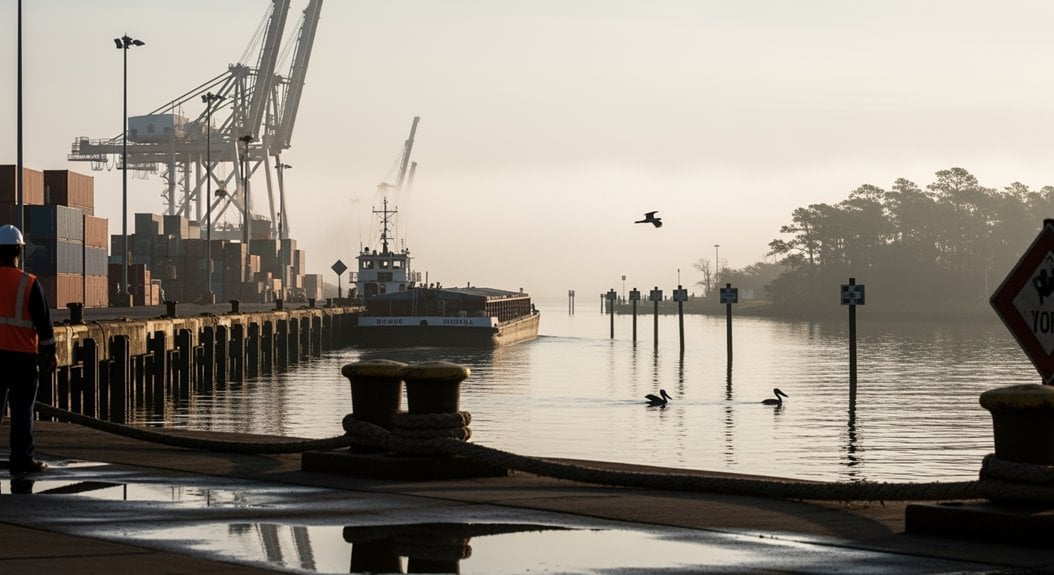
Common Longshore and Dock Worker Accidents in Mississippi
Working on Mississippi’s docks and waterfront terminals exposes longshore workers to some of the most dangerous conditions in American industry. You face constant threats from heavy machinery, shifting cargo, and environmental hazards that can cause life-altering injuries.
The most common accidents include:
- Crushing injuries from containers, forklifts, and crane operations
- Slip and fall incidents on wet or debris-covered surfaces
- Caught-between accidents involving cargo and equipment
- Chemical exposure from spills or leaking containers
Poor dock ergonomics and demanding shift scheduling compound these risks, causing fatigue-related accidents when workers handle dangerous equipment during extended hours or overnight operations. OSHA’s marine terminal standards emphasize hazard communication, equipment inspections, and safe cargo handling procedures to reduce these risks under the OSHA Marine Terminals guidance.
Longshore and Port Worker Injury Statistics in Mississippi
While Mississippi’s statewide workplace injury data doesn’t isolate longshore workers into a separate category, the available statistics reveal concerning patterns that directly affect those working in port facilities and waterfront operations. In 2023, Mississippi recorded 9,349 workplace injury claims with seasonal trends showing peak incidents in August.
County hotspots include:
- Hinds County: 948 claims (highest)
- Desoto County: 763 claims
- Harrison County: significant waterfront activity
- Jackson County: major port operations
Transportation and material moving occupations, which include longshore workers, face national fatality rates of 13.6 per 100,000 workers, with strains, falls, and lifting injuries comprising the most common incident types. According to the BLS CFOI, fatal occupational injuries among transportation and material moving workers are prominently captured in Table A-1 by event and exposure categories such as falls, contact with objects, and transportation incidents.
Insurance companies know our reputation. They know we prepare every case for trial and we’ll go the distance when settlement offers fall short. We investigate thoroughly, build bulletproof cases, and aren’t afraid to take yours to court. That changes negotiations from the start.
Anytime. Anywhere. We’re Ready to Fight for You.
Compensation Available for Longshoremen in Mississippi
If you've been injured while working as a longshoreman in Mississippi, the Longshore and Harbor Workers' Compensation Act provides several types of compensation to help you recover financially. These benefits go beyond basic workers' compensation and are specifically designed to address the unique risks maritime workers face.
Understanding what you're entitled to receive can help you make certain you're getting the full compensation the law guarantees you.
Medical Benefits
Under the Longshore and Harbor Workers' Compensation Act, injured maritime workers in Mississippi are entitled to thorough medical coverage for work-related injuries and illnesses. You'll receive full payment for all reasonable and necessary medical care, including doctor visits, surgeries, medications, physical therapy, and medical equipment. The insurance carrier must provide treatment authorization within fourteen days of your request.
If they deny coverage, you can select your own physician and seek medical reimbursement through the claims process. You're entitled to choose your treating physician after the initial examination, ensuring you receive appropriate care from qualified medical professionals.
Disability Benefits
When a longshore or harbor worker suffers a work-related injury in Mississippi, the Longshore and Harbor Workers' Compensation Act provides four distinct categories of disability benefits based on your injury's severity and duration.
- Temporary total disability covers you while recovering and unable to work.
- Temporary partial disability applies when you can perform limited duties at reduced earnings.
- Permanent partial disability compensation depends on disability ratings assigned by medical professionals.
Permanent total disability benefits continue indefinitely for workers who can't return to any gainful employment, though you may qualify for vocational rehabilitation services to explore alternative career options suited to your capabilities.
Death Benefits
The sudden loss of a maritime worker creates devastating emotional and financial consequences for families who depended on that income. Under the Longshore Act, eligible survivors receive compensation equal to two-thirds of the deceased worker's average weekly wage. This survivor support continues for specific periods based on your relationship to the deceased. You're also entitled to burial allowances up to $3,000 to help cover funeral expenses.
Eligible beneficiaries typically include spouses, children, and sometimes dependent parents or siblings. These benefits guarantee your family maintains financial stability during an impossibly difficult time while honoring your loved one's contributions.
Additional Damages
Beyond basic medical and wage replacement benefits, you're entitled to pursue additional compensation when third-party negligence contributed to your longshore injury. If equipment manufacturers, vessel owners, or contractors caused your accident, you can file separate lawsuits outside the Longshore Act. These claims may include compensation for emotional distress, which addresses psychological suffering like anxiety and depression following your injury.
In cases involving particularly reckless conduct, you might recover punitive damages designed to punish wrongdoers and deter future misconduct. These additional recoveries can substantially increase your total compensation beyond standard Longshore benefits, providing more complete financial recovery.
Statute of Limitations for Filing a LHWCA Claim
Time limits matter critically in Longshore and Harbor Workers' Compensation Act cases, and missing a deadline can destroy your right to compensation permanently. You must notify your employer within thirty days of your injury and file your formal claim within one year. These filing deadlines aren't flexible under most circumstances.
Exceptions exist through claim tolling, which pauses the clock in specific situations like ongoing medical treatment or employer fraud. Insurance companies won't remind you when deadlines approach. They benefit when injured workers miss critical dates. Contact an experienced LHWCA attorney immediately to protect your rights and prevent devastating procedural losses.
Get Results
Each one of our lawyers is a skilled and experienced litigator and negotiator. We never recommend settling your case when trial presents a better opportunity for recovery.



Why Do I Need a Longshoremen Workers Comp Injury Lawyer?
Maritime employers and insurance carriers deploy specialized legal teams immediately after workplace accidents occur, and you'll face these experienced professionals alone without proper representation.
An experienced longshore attorney levels this imbalance by developing a thorough legal strategy tailored to your specific circumstances. Your lawyer handles complex benefits negotiation while you focus on recovery, ensuring insurance adjusters don't minimize your injuries or rush you into inadequate settlements.
Professional representation protects your right to full compensation, including medical treatment, wage replacement, and permanent disability benefits. Without skilled advocacy, you risk accepting far less than your claim's true value.
Why Choose Grossman Attorneys for Your Mississippi LHWCA Claim
When you're injured while working under the Longshore and Harbor Workers' Compensation Act in Mississippi, you need attorneys who won't back down from insurance companies or accept settlements that fall short of what you deserve.
Grossman Attorneys at Law has spent over 40 years building a national reputation for aggressive advocacy and courtroom excellence in longshore injury cases. Our maritime law firm has secured substantial settlements and verdicts in cases ranging from Defense Base Act claims to longshoremen workers' comp injury cases and offshore accidents. We understand the complex laws that govern these claims and stand ready to take your case to trial when insurance companies fail to offer the fair compensation you deserve.
Aggressive But Fair Representation
Because insurance companies employ teams of lawyers to minimize payouts, you'll need equally determined representation to level the playing field. Grossman Attorneys combines assertive advocacy with ethical negotiation to maximize your compensation without compromising professional standards. We prepare every case for trial, signaling to insurers that we won't accept lowball offers. This litigation-first approach consistently produces superior results. Defense attorneys recognize our thorough preparation and courtroom capabilities, which strengthens settlement negotiations.
Our reputation for taking cases to verdict when necessary motivates insurance carriers to present fair offers. You deserve compensation that fully addresses your injuries and losses.
Experienced, Compassionate Staff
After an injury disrupts your livelihood and threatens your financial security, you'll work with a legal team that understands both the complexities of LHWCA law and the personal challenges you're facing.
Our staff provides trauma informed care, recognizing that workplace injuries affect more than just your physical health. They impact your emotional wellbeing, family relationships, and financial stability.
We've built our team to address these realities with sensitivity and professionalism. Our multilingual support guarantees clear communication regardless of your preferred language, eliminating barriers that might otherwise prevent you from fully understanding your rights and receiving the compensation you deserve.
A Track Record of Winning Longshore Claims
Our firm's success in longshore cases stems from a fundamental commitment that sets us apart from attorneys who primarily settle claims: we're prepared to litigate your case fully when insurance carriers refuse fair compensation. Defense attorneys and insurers recognize our trial preparedness, which strengthens negotiations considerably. With over 40 years of experience, we've secured numerous multi-million-dollar settlements through effective verdict strategies that demonstrate exactly what your case is worth in court.
This litigation-first approach consistently achieves maximum compensation because carriers know we won't accept inadequate offers. Your case receives the thorough preparation necessary to win at trial if settlement discussions fail.
Injured at a Mississippi Port? Let Grossman Attorneys Fight for Your LHWCA Compensation
If you or a loved one has suffered an injury while working at a Mississippi port, you don't have to face the complex LHWCA claims process alone. Grossman Attorneys at Law has over 40 years of experience fighting for maritime workers' rights and securing the maximum compensation they deserve. We appreciate the physical, emotional, and financial challenges you're facing, and we're prepared to take your case to trial if necessary to guarantee you receive fair treatment. Insurance carriers know our reputation for thorough preparation and aggressive advocacy.
Don't settle for less than you deserve. Contact Grossman Attorneys today to speak with an experienced LHWCA attorney who'll prioritize your recovery and fight tirelessly for your rights.
*If you hire Grossman Attorneys for your LHWCA case, you pay no attorney fees for our service. When we win your case, the employer or its insurer typically pays a DOL-approved attorney’s fee and any case expenses we advanced are reimbursed from the recovery. If we don't win, you pay nothing.
- https://shipmspa.com/doing-business/business/facilities-properties/
- https://www.bts.gov/sites/bts.dot.gov/files/portprofiles/2018/Gulfport.pdf
- https://mdot.ms.gov/ports/index.html
- https://bluewatershipping.com/portinfolocations.php?id=2
- https://www.maritime.dot.gov/data-reports/ports/list
- https://idot.illinois.gov/content/dam/soi/en/web/idot/documents/transportation-system/reports/opp/marine/upper_mississippi_river_international_port_district_profile.pdf
- https://experience.arcgis.com/experience/9c9a25b001144a5f9f8523d5bcc12cff
- https://mdot.ms.gov/portal/portsx
- https://rosap.ntl.bts.gov/view/dot/14506/dot_14506_DS1.pdf
- https://portnola.com/business/private-maritime-facilities