


Top Rated Florida Longshoreman injury Law Firm – Grossman Attorneys
If you’ve been injured working Florida’s docks, shipyards, or ports, you need an attorney who understands the federal laws protecting longshore and harbor workers. The Longshore and Harbor Workers’ Compensation Act provides benefits different from standard workers’ comp, but obtaining them requires navigating strict deadlines and complex procedures while facing insurers trained to minimize payouts.
Grossman Attorneys at Law has extensive experience handling LHWCA claims for injured maritime workers throughout Florida. Our team knows how to build compelling cases, negotiate aggressively with insurance companies, and take matters to trial when fair settlements aren’t offered. We’ve recovered significant compensation for longshoremen facing medical bills, lost wages, and uncertain futures.
Your injury shouldn’t cost you your livelihood or financial stability. Contact Grossman Attorneys at Law today for a free consultation. Let us fight for the full benefits you’ve earned through your hard work and sacrifice.
Understanding the Longshore and Harbor Workers’ Compensation Act (LHWCA)
If you’ve been injured while working on or near navigable waters in Florida, the Longshore and Harbor Workers’ Compensation Act (LHWCA) likely governs your right to compensation.
This federal law provides specific benefits and protections for maritime workers who don’t qualify as seamen under the Jones Act, creating a distinct framework that differs markedly from both standard workers’ compensation and other maritime injury laws.
Understanding whether you’re covered under the LHWCA, what benefits you can receive, and how this law compares to other options is essential for protecting your rights and securing the full compensation you deserve.
Under the LHWCA, eligible workers may receive medical care without deductibles or copays and disability payments based on pre-injury wages, which are adjusted annually using the National Average Weekly Wage.
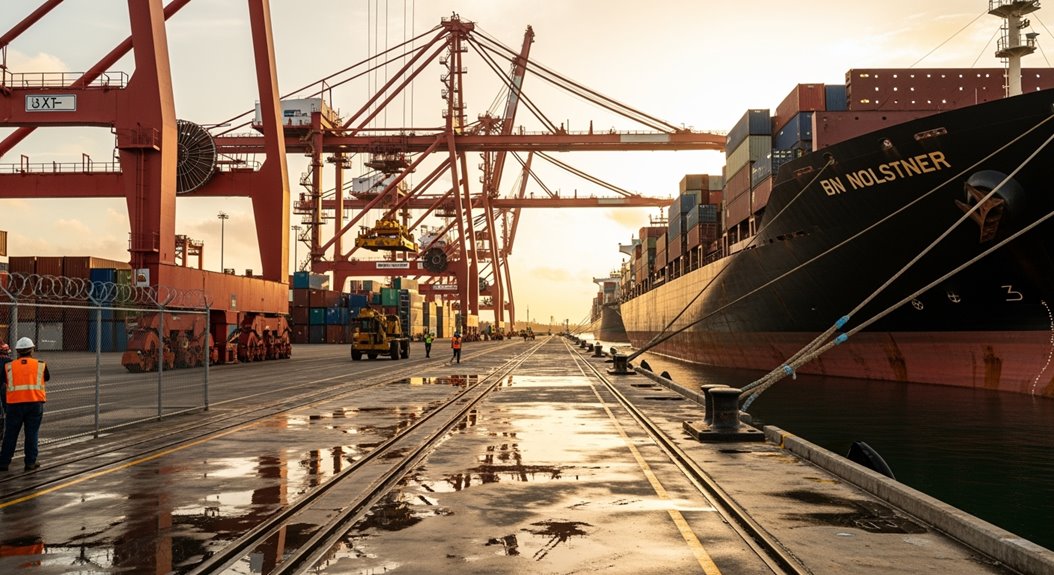
What is LHWCA Coverage?
When you’re injured while working on navigable waters or in maritime employment, the Longshore and Harbor Workers’ Compensation Act (LHWCA) provides critical benefits that standard workers’ compensation doesn’t cover.
The LHWCA scope extends to dock workers, shipbuilders, harbor construction workers, and others performing maritime work on or near navigable waters. This federal law offers medical treatment, disability payments, and vocational rehabilitation.
Coverage limits are more generous than typical state workers’ compensation, including two-thirds of your average weekly wages for temporary disability and compensation for permanent impairments. Understanding your LHWCA eligibility assures you receive the maximum benefits you deserve.
You also have the right to choose your own treating physician under the LHWCA, with changes requiring permission from the employer, insurer, or OWCP.
Who Qualifies for LHWCA Benefits?
Qualifying for LHWCA benefits depends on two essential tests: the status test and the situs test.
You’ll meet the status test if you’re a maritime employee, not a vessel crew member or master. The situs test requires that your injury occurred on navigable waters or in an adjoining area used for maritime activities like loading, unloading, repairing, or building vessels.
The longshore act covers injuries while working on:
- Ports
- Piers
- Wharves
- Docks
- Dry Docks
- Terminals
- Shipyards
- Marine Railways
- Other adjoining areas customarily used for vessel-related activities under the Longshore Act.
Covered employers include stevedoring companies, shipbuilders, marine terminals, and harbor construction firms. Understanding these eligibility criteria helps determine whether you’re entitled to LHWCA benefits. Both tests must be satisfied for coverage.
How Does LHWCA Differ from Other Maritime Laws?
The maritime legal system creates distinct pathways for different types of workers, and understanding where LHWCA fits among these options directly affects your compensation and legal rights.
Unlike the Jones Act, which requires proving employer negligence, LHWCA operates as a no-fault system. You’ll receive benefits regardless of who caused your injury. The jurisdictional scope covers maritime workers on navigable waters and adjoining areas like docks and piers, while excluding vessel crew members.
LHWCA limits employer liability to specific benefits, preventing lawsuits for pain and suffering. This trade-off guarantees faster compensation but restricts your recovery options compared to traditional maritime lawsuits.
Major Ports and Maritime Facilities in Florida
PortMiami (Port of Miami)
Located in Miami-Dade County along Biscayne Bay, PortMiami serves as a critical gateway for international trade and cruise operations in South Florida. Major companies operating at the facility include Mediterranean Shipping Company (MSC), CMA CGM, Crowley Maritime, and numerous cruise lines such as Carnival, Royal Caribbean, and Norwegian Cruise Line.
The port handles diverse cargo including containerized goods, perishables, and break-bulk cargo while simultaneously serving as the world’s busiest cruise port. PortMiami processes over 1.25 million twenty-foot equivalent units (TEUs) annually and welcomes more than 7 million cruise passengers each year. The port employs approximately 334,000 people directly and indirectly throughout Florida and generates over $43 billion in annual economic impact.
Recent infrastructure investments exceed $1 billion, including the deepening of the shipping channel to 50-52 feet to accommodate Post-Panamax vessels and construction of an on-dock intermodal rail facility. Explore federal maritime datasets and dashboards via the MARAD Data & Reports portal to compare port performance, safety trends, and economic impacts across Florida’s seaports.
Port Everglades
Situated in Broward County between Fort Lauderdale and Hollywood, Port Everglades ranks as one of Florida’s busiest seaports and the state’s leading petroleum port. Major tenant companies include Florida Power & Light, Port Everglades Fuel Terminals, Royal Caribbean Cruises, Carnival Cruise Line, and container shipping operators such as TOTE Maritime and King Ocean Services.
The port specializes in petroleum products, containerized cargo, cruise operations, and bulk commodities. Port Everglades handles approximately 1.1 million TEUs, 3.8 million cruise passengers, and over 120 million barrels of petroleum products annually.
Florida’s deepest port at 42-48 feet, the facility supports roughly 13,000 direct jobs and 229,000 jobs statewide, contributing approximately $33.9 billion in annual economic activity. The port is undergoing a $3 billion capital improvement program including deeper and wider navigation channels, expanded container terminals, and enhanced fuel storage facilities.
JAXPORT (Jacksonville Port Authority)
Located in Jacksonville along the St. Johns River in Northeast Florida, JAXPORT operates multiple marine terminals including Blount Island, Dames Point, and Talleyrand.
The port hosts major companies such as SSA Marine, Trapac, TOTE Services, SSAB Americas (steel), and is a primary entry point for automotive imports from manufacturers including Hyundai, Kia, and Subaru. JAXPORT specializes in vehicles, containers, breakbulk cargo, and dry bulk commodities.
JAXPORT ranks among the nation’s top vehicle-handling ports, processing over 700,000 vehicles annually along with approximately 1.4 million TEUs. The port supports more than 138,000 jobs throughout Florida and generates $31 billion in annual economic impact. Recent investments include a $420 million harbor deepening project to 47 feet, modernized container terminal facilities, and expanded on-dock rail capabilities. The port employs thousands of longshore workers covered under the Longshore and Harbor Workers’ Compensation Act (LHWCA).
Port Tampa Bay
Positioned along Tampa Bay in Hillsborough County, Port Tampa Bay is Florida’s largest port by land area and tonnage, encompassing multiple cargo facilities throughout the bay.
Major companies operating at the port include Mosaic (phosphate), CF Industries (fertilizer), PCS Phosphate, Kinder Morgan (petroleum), and TECO Energy. The port specializes in bulk commodities including phosphate, petroleum products, liquid bulk, steel, and containers.
Port Tampa Bay handles approximately 34 million tons of cargo annually, making it one of the nation’s largest bulk cargo ports. The facility supports over 100,000 direct and indirect jobs and contributes approximately $17.2 billion to Florida’s economy each year.
The port maintains extensive maritime infrastructure including specialized bulk handling equipment, liquid cargo terminals, and deepwater channels at 43 feet. Ongoing capital improvements focus on infrastructure modernization and environmental sustainability measures.
Port Canaveral
Located on Florida’s Space Coast in Brevard County, Port Canaveral operates as both a major cruise port and cargo facility adjacent to Cape Canaveral Space Force Station.
The port serves cruise lines including Carnival, Disney, Royal Caribbean, and Norwegian, while cargo operations include companies handling project cargo, bulk commodities, and containerized goods.
Port Canaveral specializes in cruise operations, launch vehicle components, bulk cargo, and general cargo. Port Canaveral processes over 4 million cruise passengers annually, ranking among the world’s busiest cruise ports, and handles approximately 4.4 million tons of cargo. The port supports more than 23,000 jobs and generates over $3.5 billion in economic impact for the region.
Recent infrastructure investments include expanded cruise terminals, the addition of new cargo berths, and channel improvements. The port employs longshore workers for cargo operations who are covered under LHWCA protections for workplace injuries and occupational hazards.
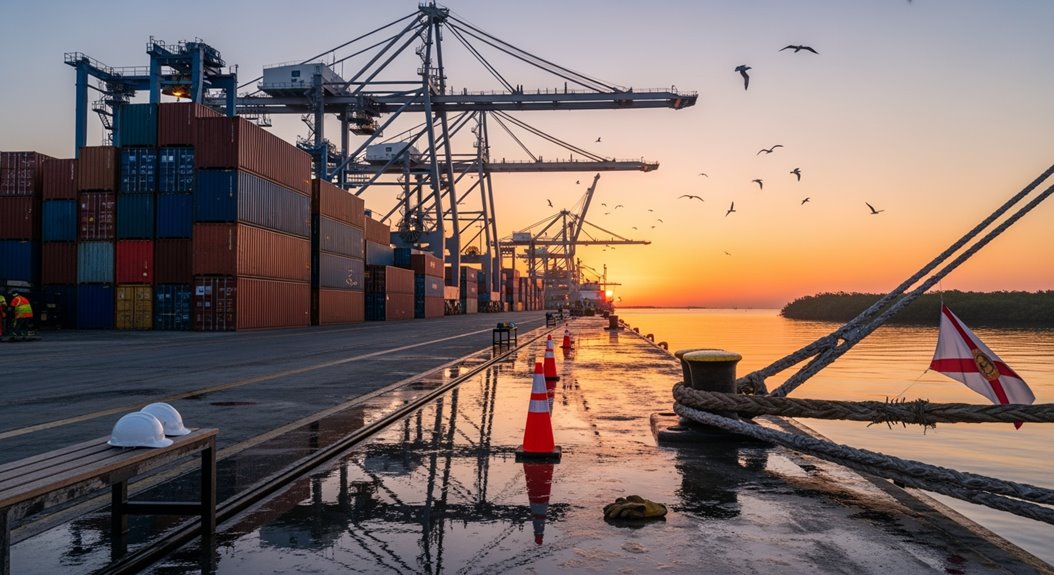
Common Longshore and Dock Worker Accidents in Florida
Florida’s bustling maritime industry employs thousands of longshore and dock workers across major ports like PortMiami, Port Everglades, and JAXPORT, but this critical workforce faces materially daily hazards.
These workers encounter serious risks including:
- Devastating slip and fall injuries from wet decks and inadequate guardrails that can end careers instantly
- Crushing equipment accidents from machinery failures and cargo handling errors
- Life-threatening collisions with fixed objects and vessels in crowded dock areas
- Severe injuries caused by overloaded cargo and improper loading procedures
- Heat exhaustion and dangerous exposures worsened by demanding shift scheduling
- Back Injuries
- Herniated Disc Injuries
- Spinal Cord Injuries
- Neck Injuries
- Shoulder Injuries
- Hearing and Vision Loss
- Wrongful or Accidental Death
- Asbestos-related injuries, such as Mesothelioma
OSHA highlights common longshoring hazards and provides resources for marine terminals to improve safety practices.
Longshore and Port Worker Injury Statistics in Florida
Every year, thousands of longshore and port workers in Florida sustain serious injuries while keeping America’s maritime commerce flowing.
Miami-Dade County alone records over 8,300 workplace injuries annually across all sectors, with maritime operations representing a significant portion. Despite improvements in port ergonomics and fatigue management, these environments remain exceptionally dangerous.
Common injury patterns include:
- Crushing injuries from heavy machinery and cargo handling equipment
- Amputations during loading and unloading operations
- Falls from heights on ships and dock structures
- Repetitive stress injuries from constant physical labor
- Burns and chemical exposures in hazardous cargo situations
Nationally, longshore occupations consistently exceed general industry averages for serious injuries and fatalities. According to BLS CFOI 2022 data, transportation and warehousing recorded one of the highest fatality counts, with many deaths linked to contact with objects and falls in port-related operations.
Insurance companies know our reputation. They know we prepare every case for trial and we’ll go the distance when settlement offers fall short. We investigate thoroughly, build bulletproof cases, and aren’t afraid to take yours to court. That changes negotiations from the start.
Anytime. Anywhere. We’re Ready to Fight for You.
Compensation Available for Longshoremen in Florida
If you've suffered a workplace injury as a longshoreman in Florida, the Longshore and Harbor Workers' Compensation Act provides you with several types of financial protection.
Understanding what benefits you're entitled to can help you secure the full compensation needed for your recovery and financial stability.
These benefits fall into four main categories: medical care coverage, disability payments, death benefits for families, and potential additional damages in certain circumstances.
Medical Benefits
Recovering from a serious workplace injury requires access to thorough medical treatment, and the Longshore and Harbor Workers' Compensation Act guarantees you won't bear the financial burden of that care.
Your employer's insurance carrier must cover all reasonable and necessary medical expenses related to your injury, including doctor visits, surgeries, hospitalization, and medications.
However, insurers often create obstacles through treatment denials, medical billing disputes, pharmacy disputes, and inadequate rehabilitation oversight. These tactics aim to minimize their financial exposure at your expense. An experienced longshore attorney makes certain you receive the complete medical care your recovery demands without facing inappropriate delays or denials.
Disability Benefits
Beyond medical treatment, the Longshore and Harbor Workers' Compensation Act provides multiple forms of disability benefits designed to replace lost wages when your injury prevents you from working.
You may qualify for temporary total disability if you're unable to work during recovery, or partial disability if you can return to modified duties at reduced earnings. Permanent total disability provides lifetime benefits when injuries prevent any substantial gainful employment.
If you can't return to your previous position, you're entitled to vocational rehabilitation services that help you develop new skills for alternative work within your medical restrictions.
Death Benefits
When a longshore worker dies from injuries sustained on the job, the Longshore and Harbor Workers' Compensation Act provides financial support to surviving family members who depended on that worker's income.
These death benefits typically cover funeral expenses up to $3,000 and provide ongoing weekly payments to surviving spouses and dependent children. The amount depends on the worker's average weekly wage at the time of death. Benefits may also include survivor counseling to help family members cope with their loss.
You'll need to file specific documentation proving your relationship and financial dependency to receive these benefits.
Additional Damages
While the Longshore and Harbor Workers' Compensation Act provides weekly wage replacement and medical benefits, injured longshoremen in Florida may qualify for additional forms of compensation that substantially increase their total recovery.
You might receive compensation for emotional distress when your injury causes significant psychological harm, including anxiety, depression, or trauma. In cases involving employer misconduct or deliberate safety violations, punitive damages may be available through separate legal claims. These damages punish wrongdoing and deter future violations.
Third-party liability claims against equipment manufacturers, vessel owners, or contractors can provide compensation beyond standard longshore benefits, potentially recovering damages unavailable under the Act.
Statute of Limitations for Filing a LHWCA Claim
Understanding time limits becomes critical after you've suffered a workplace injury under the Longshore and Harbor Workers' Compensation Act.
You must notify your employer within 30 days of your accident and file your claim within one year of the injury or from when you discovered your work-related condition. These claim deadlines are strict, and missing them typically bars your right to compensation. However, filing exceptions exist for cases involving employer fraud, serious misconduct, or circumstances beyond your control.
Don't risk losing your benefits by waiting. Contact our experienced Longshore attorneys immediately to protect your rights and meet all critical deadlines.
Get Results
Each one of our lawyers is a skilled and experienced litigator and negotiator. We never recommend settling your case when trial presents a better opportunity for recovery.



Why Do I Need a Longshoremen Workers Comp Injury Lawyer?
Because Longshore and Harbor Workers' Compensation Act cases involve complex federal regulations that differ markedly from standard workers' compensation laws, attempting to handle your claim alone puts you at a serious disadvantage.
Insurance carriers employ experienced defense attorneys who understand these intricate regulations and use that knowledge to minimize payouts. A specialized longshore attorney conducts thorough pre injury investigation to establish your claim's foundation, protecting your rights through attorney client privilege while building the strongest possible case.
Without legal representation, you're vulnerable to insurance tactics designed to reduce your compensation or deny valid claims entirely.
Why Choose Grossman Attorneys for Your Florida LHWCA Claim
When you're recovering from a maritime injury and fighting for the benefits you've earned, you need attorneys who'll stand up to insurance companies and employers without backing down.
Grossman Attorneys at Law is a respected maritime law firm with over 40 years of experience representing injured workers across the nation. Our maritime attorneys have secured substantial settlements and verdicts in cases ranging from Defense Base Act claims to longshoremen workers' comp injury cases and offshore accidents. We understand the complex laws that govern these claims and stand ready to take your case to trial when insurance companies fail to offer the fair compensation you deserve.
Aggressive But Fair Representation
Insurance companies and their defense teams know which law firms will fight for every dollar their clients deserve and which ones routinely settle for less. Grossman Attorneys has built its reputation on tough negotiation backed by proven courtroom results.
When insurers offer insufficient compensation, we're prepared to take your case to trial. Our ethical advocacy means we'll aggressively pursue maximum benefits while maintaining professional standards that strengthen your case.
We don't use pressure tactics or make unrealistic promises. Instead, we combine thorough preparation with strategic advocacy to achieve results that reflect the true value of your claim.
Experienced, Compassionate Staff
Throughout your LHWCA claim, you'll work directly with professionals who understand both the legal complexities and the personal hardships you're facing.
Our staff brings decades of combined experience handling maritime injury cases, so they'll recognize what you're going through and what you'll need during recovery. They'll help with benefits navigation, ensuring you receive every payment you're entitled to under the law.
When you need resources beyond legal representation, such as trauma counseling referrals, our team can point you toward appropriate support services. You're not just another case file. You're someone who deserves dedicated attention and genuine care.
A Track Record of Winning Longshore Claims
Because settlement negotiations only succeed when insurance companies recognize your attorney's willingness to litigate, Grossman Attorneys at Law has built a reputation that commands respect in settlement discussions and courtrooms alike.
Our trial victories against Fortune 500 companies and major insurers demonstrate we're prepared to fight for maximum compensation. Client testimonials consistently highlight our thorough preparation and commitment to securing fair outcomes.
With over 40 years of maritime litigation experience and numerous multi-million-dollar settlements, we've proven our ability to win complex Longshore claims. Insurance adjusters understand we don't accept inadequate offers, strengthening your negotiating position from day one.
Injured at a Florida Port? Let Grossman Attorneys Fight for Your LHWCA Compensation
If you or a loved one has been injured while working at a Florida port, you don't have to face the complex LHWCA claims process alone. Grossman Attorneys at Law has spent over 40 years fighting for injured maritime workers just like you, securing the maximum compensation they deserve.
We appreciate the physical, emotional, and financial toll these injuries take on workers and their families. Our litigation-first approach means we're prepared to take your case to trial if insurance carriers refuse to offer fair compensation. Defense attorneys know we don't back down from a fight.
Don't settle for less than you're entitled to under the Longshore and Harbor Workers' Compensation Act. Contact Grossman Attorneys today to speak with an experienced LHWCA attorney about your case.
*If you hire Grossman Attorneys for your LHWCA case, you pay no attorney fees for our service. When we win your case, the employer or its insurer typically pays a DOL-approved attorney’s fee and any case expenses we advanced are reimbursed from the recovery. If we don't win, you pay nothing.
- https://www.marineinsight.com/know-more/ports-in-florida/
- https://dos.fl.gov/library-archives/research/florida-information/business/seaports-of-florida/
- https://www.dgdtransport.com/notable-ports-in-florida/
- https://www.maritime.dot.gov/data-reports/ports/list
- https://www.fdot.gov/seaport/default.shtm
- https://www.cruisecritic.com/articles/cruise-ports-florida-what-to-know
- https://warehousingetc.com/florida-ports-powering-logistics-from-coast-to-coast/
- https://www.staugustine.com/story/news/environment/2025/05/28/florida-leads-the-nation-in-the-number-of-annual-boating-fatalities/83818055007/